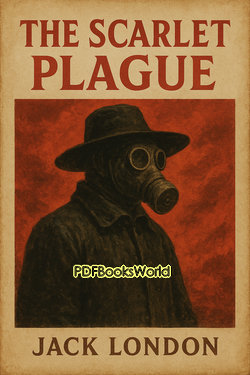
The Scarlet Plague: Jack London’s Haunting Vision of a World Destroyed by Pandemic
The Scarlet Plague, written by Jack London and published in 1912, is one of the earliest and most striking works of post-apocalyptic fiction. Long before modern pandemic stories became popular, London imagined a future where civilization collapses after a deadly disease wipes out most of humanity. Set in the distant future of 2073, the novel presents a haunting world where knowledge, technology, and social order have almost completely vanished.
A Future Where Civilization Has Disappeared
The story follows James Howard Smith, an elderly survivor of the catastrophic plague who is now known simply as “Granser.” Once a university professor living in a modern society, he now wanders through the ruins of California with his grandsons, who have grown up in a primitive tribal world with little understanding of the past.
As Granser describes the terrifying spread of the Scarlet Plague, readers witness how quickly civilization collapsed under panic, disease, violence, and fear. Cities emptied, governments failed, and millions died within days as society disintegrated into chaos.
A Frighteningly Modern Pandemic Story
One reason The Scarlet Plague feels so powerful today is how realistic many aspects of its pandemic feel. Jack London imagined quarantine failures, social panic, mass migration, economic collapse, and public fear decades before modern global health crises made such scenarios familiar to readers.
The disease itself is terrifying because of its speed and certainty. Victims develop scarlet-colored skin and die rapidly, leaving almost no chance of survival. London uses the plague not simply as horror, but as a way to examine how fragile civilization truly is.
The Collapse of Knowledge and Culture
A central theme of the novel is the disappearance of human knowledge. Granser desperately tries to explain science, education, technology, and history to his grandsons, but they struggle to understand concepts from the old world.
This loss of knowledge creates one of the novel’s most emotional and unsettling elements. The ruins of civilization still exist physically, yet the understanding of how that civilization functioned has nearly vanished completely.
Human Nature Under Extreme Conditions
Jack London explores how fear and survival instincts reshape human behavior during catastrophe. As the plague spreads, ordinary social structures disappear and people become driven by panic, violence, selfishness, and desperation.
At the same time, the novel questions whether humanity ever truly escapes its primitive instincts. London suggests that beneath modern civilization, human survival behavior remains deeply connected to humanity’s ancient past.
The Atmosphere of Ruin and Isolation
The abandoned cities, empty coastlines, and overgrown ruins create a haunting atmosphere throughout the novel. Wild animals roam through places once crowded with people, while the surviving humans live in small tribal communities with primitive weapons and limited language.
This contrast between the advanced world that once existed and the primitive society that replaces it gives the novel much of its emotional and philosophical impact.
The Novel’s Importance in Science Fiction
The Scarlet Plague became an important early influence on post-apocalyptic and dystopian fiction. Many later stories involving pandemics, collapsed civilizations, and survival in ruined societies reflect ideas that Jack London explored long before the genre became popular.
The novel also remains notable because of how accurately it anticipates modern fears surrounding global disease outbreaks and social instability.
Final Thoughts
The Scarlet Plague remains one of Jack London’s most thought-provoking and unsettling works. Through its bleak future setting, emotional storytelling, and exploration of civilization’s fragility, the novel continues to feel surprisingly relevant more than a century after it was written.
For readers interested in dystopian fiction, survival stories, and classic literature exploring pandemics and the collapse of society, this novel remains a fascinating and unforgettable reading experience.