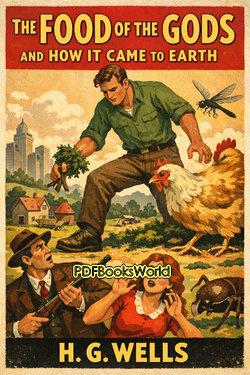
The Food of the Gods and How It Came to Earth
by H. G. Wells
A Strange Scientific Discovery That Changes the World Forever
The Food of the Gods and How It Came to Earth by H. G. Wells is a fascinating science fiction novel that combines scientific imagination, satire, and social commentary. The story begins with the invention of a mysterious substance capable of causing living things to grow to enormous size. What starts as a scientific experiment soon transforms society in unexpected and dangerous ways.
Through giant animals, oversized children, and social conflict, Wells explores humanity’s relationship with scientific progress, fear of change, and the struggle between old traditions and emerging ideas. The novel blends fantasy and philosophy while maintaining the adventurous spirit found in many of Wells’s most famous works.
The Discovery of the Extraordinary Substance
The story centers on two scientists who accidentally create a growth formula known as “Herakleophorbia IV,” often called the “Food of the Gods.” Any creature exposed to it begins growing far beyond normal size.
At first, the experiments appear amusing and harmless. However, giant insects, rats, chickens, and plants soon begin creating chaos, revealing the dangerous consequences of uncontrolled scientific discovery.
A Society Struggling to Accept Change
As giant children begin to appear, society reacts with fear and hostility. Many ordinary people view these larger and stronger individuals as threats to social order and traditional life.
Wells uses this conflict to examine how societies often resist anything new, unfamiliar, or disruptive. The giants become symbols of change, progress, and human evolution.
Characters
- Mr. Bensington – An ambitious scientist whose experiment changes the world
- Professor Redwood – A fellow researcher connected to the discovery
- The giant children – Figures representing growth, transformation, and the future
- Ordinary citizens fearful of social and scientific change
- Authorities attempting to control the consequences of the discovery
The characters reflect different attitudes toward science, progress, fear, and social responsibility.
Themes
- The power and danger of scientific experimentation
- Society’s fear of change and difference
- Human progress and evolution
- The conflict between old traditions and new ideas
- The unpredictability of technological advancement
These themes give the novel both imaginative excitement and philosophical depth.
H. G. Wells’s Blend of Satire and Science Fiction
Wells combines thrilling scientific fantasy with sharp social satire. While the giant creatures and oversized humans create dramatic and sometimes humorous situations, the novel also criticizes narrow-mindedness and resistance to intellectual progress.
The story’s imaginative premise allows Wells to discuss real social fears surrounding science, modernity, and social transformation.
A Story About Growth Beyond Physical Size
Although physical growth is central to the plot, the novel also explores broader ideas about intellectual and social growth. The giant children symbolize future generations capable of surpassing the limitations of the past.
Wells suggests that humanity must either adapt to change or remain trapped by fear and outdated thinking.
Why the Novel Continues to Fascinate Readers
The Food of the Gods and How It Came to Earth remains engaging because of its originality, imaginative storytelling, and social relevance. The novel raises timeless questions about science, responsibility, and the way societies react to rapid change.
For readers interested in classic science fiction, speculative ideas, and socially conscious literature, the novel offers an entertaining and thought-provoking exploration of progress, fear, and the future of humanity.
Similar Genres
About the Author

H. G. Wells helped redefine the boundaries of imagination by transforming science fiction into a powerful form of literary storytelling. Born in England in 1866, he combined a keen interest in science with an extraordinary gift for narrative, producing novels that entertained readers while encouraging them to think about the future of humanity. Explore H. G. Wells books to discover the author's life, literary career, and access notable works, including The War of the Worlds, The Time Machine, Tales of Space and Time, The Invisible Man , and more.