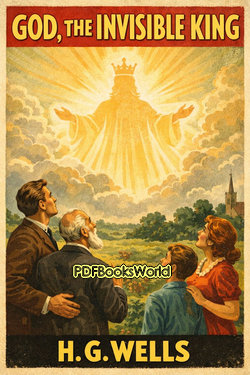
God, the Invisible King
by H. G. Wells
H. G. Wells’s Personal Search for Faith and Meaning
God, the Invisible King by H. G. Wells is a philosophical and spiritual work in which the famous author explores religion, morality, and humanity’s relationship with a higher power. Unlike his science fiction novels filled with futuristic inventions and alien worlds, this book reflects Wells’s personal thoughts about belief, society, and the spiritual direction of humanity.
The work presents Wells’s attempt to describe a modern form of faith suited to an age shaped by science, social change, and intellectual questioning. Rather than defending traditional religious systems, he proposes a more personal and evolving understanding of God and human responsibility.
A Different Kind of Religious Perspective
Wells argues that older religious traditions often struggled to keep pace with modern scientific knowledge and changing social realities. He believed many people still needed spiritual purpose and moral direction, even if they questioned traditional doctrines.
In the book, Wells describes God not as a distant ruler but as a living spiritual presence connected to human progress, conscience, and moral development.
The Relationship Between Science and Belief
One of the book’s central concerns is the tension between scientific understanding and organized religion. Wells did not reject science in favor of faith. Instead, he tried to create a spiritual outlook that could exist alongside modern knowledge and rational thinking.
The book reflects the intellectual atmosphere of the early twentieth century, when many writers and thinkers were searching for new ways to understand spirituality in a rapidly changing world.
Major Ideas Explored in the Book
- The search for a modern understanding of God
- The connection between morality and social progress
- The relationship between science and spirituality
- The importance of personal conscience and responsibility
- The future of religion in modern civilization
These ideas make the book both philosophical and deeply personal.
Wells’s Vision of Human Progress
Throughout the work, Wells expresses strong belief in humanity’s potential for improvement. He argues that moral and intellectual growth are essential for building a better future.
Rather than focusing on fear or punishment, his spiritual philosophy emphasizes cooperation, ethical responsibility, and active participation in improving society.
A Reflective and Conversational Writing Style
The tone of the book feels direct and thoughtful. Wells writes in a conversational manner, often explaining his beliefs and doubts openly rather than presenting rigid theological arguments.
This personal approach makes the work feel more like a philosophical exploration than a formal religious text.
The Historical Importance of the Work
God, the Invisible King reflects a period when many intellectuals were reconsidering traditional beliefs because of scientific discovery, industrialization, and political change. Wells’s ideas became part of broader debates about religion and modern society during the early twentieth century.
The book also reveals a lesser-known side of Wells, showing his interest in ethics, philosophy, and the future of human civilization.
Why the Book Continues to Interest Readers
Modern readers continue to find the work interesting because it addresses questions that remain relevant today. The relationship between science, spirituality, morality, and social responsibility continues to shape public discussion around the world.
For readers interested in philosophy, religion, intellectual history, and the broader ideas of H. G. Wells, the book offers a thoughtful exploration of belief and humanity’s search for meaning in a modern age.
Similar Genres
About the Author

H. G. Wells helped redefine the boundaries of imagination by transforming science fiction into a powerful form of literary storytelling. Born in England in 1866, he combined a keen interest in science with an extraordinary gift for narrative, producing novels that entertained readers while encouraging them to think about the future of humanity. Explore H. G. Wells books to discover the author's life, literary career, and access notable works, including The War of the Worlds, The Time Machine, Tales of Space and Time, The Invisible Man , and more.