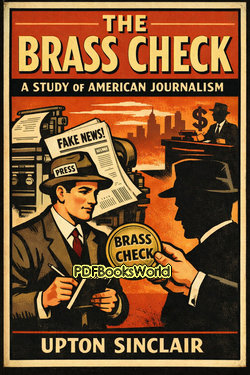
The Brass Check - A Study of American Journalism
by Upton Sinclair
Media Corruption, Public Manipulation, and the Business of American Journalism
The Brass Check - A Study of American Journalism by Upton Sinclair is a powerful investigative critique of the American newspaper industry during the early twentieth century. Published in 1919, the book examines corruption, political influence, censorship, sensationalism, and commercial manipulation within journalism while accusing major newspapers of serving wealthy interests rather than the public good.
Sinclair presents the press not as a purely independent guardian of truth, but as an institution deeply shaped by financial pressure, advertising influence, political bias, and corporate control.
The Meaning of “The Brass Check”
The title refers to the brass tokens once used in brothels, symbolizing Sinclair’s belief that sections of American journalism had effectively sold their integrity for money and influence. He argues that many newspapers distorted facts, suppressed important information, and manipulated public opinion in order to protect advertisers, political allies, and powerful economic interests.
Sinclair supports his arguments through examples of biased reporting, fabricated stories, attacks upon labor movements, and the suppression of viewpoints considered dangerous to established power.
Rather than criticizing only individual journalists, the work attacks structural problems within media ownership and the economic systems shaping news production.
The volume reflects the broader Progressive Era concern with corruption, monopolies, and the influence of wealth over democratic institutions.
Its tone combines investigative outrage with political criticism and moral urgency.
The Press and Public Opinion
A major theme throughout the book is the enormous power journalism possesses in shaping how societies understand politics, economics, war, labor, and public morality.
Sinclair repeatedly warns that when newspapers become dependent upon advertisers and wealthy owners, truthful reporting may be sacrificed for profit or political advantage.
The work also reflects growing early twentieth-century anxiety concerning propaganda, misinformation, and the vulnerability of democratic societies to manipulated media narratives.
This critique helped make the book one of the most controversial journalistic exposés of its time.
Political and Social Themes Explored Throughout the Book
- Media Corruption and Commercial Influence: Sinclair examines how advertising and ownership shape news reporting.
- Political Manipulation and Propaganda: Newspapers are accused of influencing public opinion for powerful interests.
- Censorship and Suppression of Information: Certain viewpoints and social issues receive limited or distorted coverage.
- Labor Movements and Social Inequality: Sinclair criticizes hostile treatment of workers and reform movements in the press.
- The Ethics of Journalism: The work questions whether profit-driven media can remain fully truthful and independent.
The book became one of the most famous critiques of American journalism in the twentieth century.
The Conflict Between Truth and Profit
One of the work’s strongest ideas is that commercial pressure may encourage media organizations to prioritize revenue and influence above honest reporting.
Sinclair repeatedly demonstrates how newspapers can shape public perception through omission, exaggeration, emotional manipulation, and selective presentation of facts.
The book also reveals how deeply journalism had become connected to political and economic power structures during the industrial era.
This criticism remains strikingly relevant within modern discussions concerning media ownership and public trust.
Upton Sinclair’s Investigative and Polemical Style
The Brass Check demonstrates Upton Sinclair’s remarkable ability to combine investigative research, political activism, and emotionally forceful writing into persuasive social criticism.
The prose remains direct, confrontational, and strongly focused upon exposing what Sinclair viewed as systemic dishonesty and exploitation within American journalism.
Sinclair consistently presents investigative writing as a moral responsibility aimed at protecting democratic society and public awareness.
Why the Book Still Holds Political and Historical Importance
Modern readers continue finding The Brass Check important because it raises enduring questions concerning media ethics, propaganda, corporate influence, and the relationship between journalism and democracy.
The book also provides insight into the political tensions, labor struggles, and reform movements of early twentieth-century America during a period of rapid industrial and social change.
Its discussions of censorship, misinformation, media bias, and economic pressure continue resonating within contemporary debates surrounding news organizations and public trust in journalism.
For readers interested in journalism history, political reform, media criticism, American history, investigative writing, propaganda studies, and social activism, this work remains provocative, historically significant, and intellectually influential.
Similar Genres
About the Author

Upton Sinclair was one of America's most influential novelists and social reformers, using fiction as a powerful tool to expose injustice and inspire change. Born in Maryland in 1878, Sinclair devoted his literary career to examining the lives of ordinary people affected by poverty, industrialization, political corruption, and economic inequality. Explore Upton Sinclair books to discover the author's life, literary career, and access notable works, including The Jungle, The Goose-step: A Study of American Education, The Cruise of the Training Ship, Good Health and How We Won It , and more.