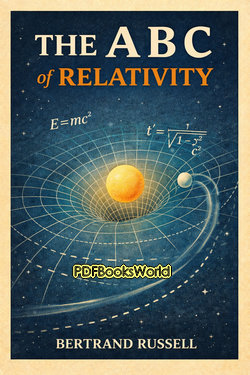
The A B C of Relativity
by Bertrand Russell
A Clear Introduction to Einstein's Revolutionary Theory
The A B C of Relativity by Bertrand Russell is one of the most accessible and influential explanations of Albert Einstein's theory of relativity written for general readers. First published in 1925, the book was created to help non-specialists understand scientific ideas that had transformed modern physics. Russell, one of the twentieth century's greatest philosophers and public intellectuals, combines clarity, logic, and wit to explain concepts that were often considered difficult or mysterious.
Rather than requiring advanced mathematical knowledge, the book focuses on the principles behind relativity, making it possible for ordinary readers to appreciate one of the most important scientific developments in history.
The Scientific Revolution of Relativity
Before Einstein, most scientists accepted the framework established by Isaac Newton. Newton's laws had successfully explained motion and gravity for centuries. However, new discoveries revealed limitations in the traditional understanding of space, time, and motion.
Einstein's theory of relativity introduced a radically different perspective. It showed that measurements of space and time depend upon the observer's frame of reference and that the universe behaves in ways that often defy everyday intuition.
Russell's Approach to Explanation
One of the book's greatest strengths is Russell's ability to explain complex ideas through simple reasoning and vivid examples. He avoids unnecessary technical language and focuses on helping readers understand why relativity was needed and what problems it solved.
His goal is not merely to describe scientific facts but to guide readers through the process of thinking that led to Einstein's discoveries.
Understanding Space and Time
A central theme of the book is the relationship between space and time. Relativity challenged the traditional view that both were fixed and absolute. Instead, Einstein demonstrated that they are interconnected and can appear differently depending on motion and perspective.
Russell carefully explains these ideas, helping readers understand how concepts that seem strange at first can be understood through logical analysis.
Highlights of the Book
- Relativity Explained: An introduction designed for general readers.
- Scientific History: The development of ideas leading to Einstein's work.
- Space and Time: Exploration of their interconnected nature.
- Logical Reasoning: Clear explanations of complex concepts.
- Accessible Science: Minimal reliance on advanced mathematics.
Key Scientific Concepts
The book discusses several important ideas associated with relativity, including the relativity of motion, the speed of light, the relationship between space and time, and the effects of gravity. Russell emphasizes the conceptual significance of these discoveries rather than focusing exclusively on technical details.
By doing so, he enables readers to grasp the broader implications of Einstein's work for science and philosophy.
Major Themes
- Scientific Inquiry: The search for deeper understanding of nature.
- Reason: Using logic to explore unfamiliar ideas.
- Discovery: Transforming knowledge through new perspectives.
- Reality: Questioning assumptions about space and time.
- Education: Making advanced ideas accessible to everyone.
Bertrand Russell's Contribution
Russell was uniquely qualified to explain relativity because of his background in philosophy, mathematics, and logic. He possessed a rare ability to communicate complex concepts with precision and simplicity. His explanation helped many readers gain confidence in approaching modern science at a time when Einstein's theories were often misunderstood.
The book remains a model of clear scientific communication.
Why the Book Remains Important
The A B C of Relativity continues to be regarded as one of the finest introductions to Einstein's ideas. Although modern science has advanced considerably since its publication, Russell's explanations remain remarkably clear and insightful.
For readers interested in physics, philosophy, and the history of science, the book offers an engaging pathway into one of humanity's greatest intellectual achievements. Its combination of clarity, logical rigor, and enthusiasm for discovery ensures its enduring value and appeal.
One of the central ideas discussed is:
This famous equation symbolizes the profound connection between matter and energy that emerged from Einstein's revolutionary work and helped reshape modern physics.
Similar Genres
About the Author

Bertrand Russell was one of the twentieth century's most influential philosophers, mathematicians, and public intellectuals. Born in Wales in 1872, he devoted his life to the pursuit of knowledge, using clear reasoning and careful analysis to examine some of humanity's most important questions. Explore Bertrand Russell books to discover the author's life, literary career, and access notable works, including Mysticism and Logic and Other Essays, The Problems of Philosophy, The Analysis of Mind, Proposed Roads to Freedom , and more.