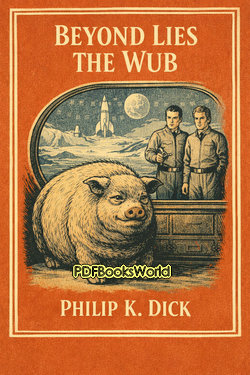
Beyond Lies the Wub
by Philip K. Dick
A Strange Alien Creature Challenges Human Ideas About Intelligence and Morality
Science fiction often imagines terrifying alien invasions or futuristic technology, but Beyond Lies the Wub by Philip K. Dick takes a quieter and far more unsettling approach. The story begins with what seems like a simple discovery on a distant planet, then gradually transforms into a disturbing meditation on intelligence, empathy, exploitation, and the limits of human understanding.
Although brief, the story introduced themes that would later define much of Philip K. Dick’s influential science fiction.
An Unusual Passenger Comes Aboard
A spaceship crew preparing to leave Mars encounters a strange alien creature called a Wub. Large, pig-like, and apparently harmless, the creature initially seems little more than an exotic animal purchased by one of the crew members.
Captain Franco, however, views the Wub mainly as food for the return journey.
Everything changes when the alien begins speaking.
The Intelligence Hidden Behind Appearance
One of the story’s central ideas involves the danger of judging intelligence according to appearance alone.
The Wub quickly reveals extraordinary intellectual ability through philosophical conversation, emotional insight, and cultural understanding.
It discusses literature, ethics, mythology, and human behavior with surprising sophistication.
This creates an uncomfortable contrast between the supposedly civilized humans and the creature they intend to consume.
Questions the Story Quietly Raises
Despite its short length, the story introduces several thought-provoking ideas.
- What defines intelligence?
- Do humans automatically assume superiority?
- Can empathy overcome selfishness and appetite?
- How should humanity treat unknown life forms?
The simplicity of the plot allows these ethical questions to emerge naturally.
Philip K. Dick’s Early Science Fiction Vision
This story was one of Philip K. Dick’s earliest published works, yet many of his future literary obsessions already appear clearly.
His fiction frequently explored:
- The uncertainty of reality
- The fragility of human identity
- Moral ambiguity
- The possibility that non-human beings may possess deeper humanity than people themselves
Beyond Lies the Wub presents these ideas in surprisingly compact form.
The Story’s Quiet but Unsettling Tone
Unlike action-heavy science fiction adventures, the tension here develops through conversation and implication. The atmosphere remains calm almost until the end, which makes the conclusion feel even more disturbing.
Dick avoids excessive explanation, allowing readers to sense moral discomfort growing beneath ordinary dialogue.
The story demonstrates how speculative fiction can provoke philosophical reflection without requiring elaborate world-building.
Why Beyond Lies the Wub Still Feels Memorable
Beyond Lies the Wub continues to attract readers because its central dilemma remains relevant in discussions about intelligence, ethics, and the treatment of other beings.
For readers interested in classic science fiction, philosophical storytelling, alien encounters, and the early work of Philip K. Dick, the story offers a compact but remarkably effective exploration of human arrogance and unexpected consciousness.
Similar Genres
About the Author

Philip K. Dick reshaped modern science fiction through stories that challenged readers to question the nature of reality, identity, and human consciousness. Born in Chicago in 1928, he wrote during a period of rapid technological and social change, producing novels and short stories that blended speculative ideas with psychological depth. Explore Philip K. Dick books to discover the author's life, literary career, and access notable works, including Second Variety, The Variable Man, The Defenders, Mr. Spaceship , and more.