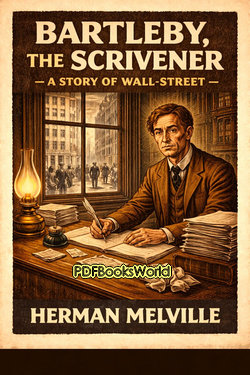
Bartleby, the Scrivener - A Story of Wall-Street
by Herman Melville
A Quiet Clerk Who Refuses the World Around Him
Bartleby, the Scrivener: A Story of Wall-Street by Herman Melville is one of the most unusual and psychologically haunting short stories in American literature. Set inside a legal office on Wall Street, the story transforms an apparently ordinary workplace into a disturbing meditation on isolation, passive resistance, modern labor, and emotional disconnection.
Melville creates tension not through violence or dramatic action, but through silence, repetition, and the mysterious behavior of a single man whose refusal to participate gradually unsettles everyone around him.
The Arrival of Bartleby
The story is narrated by an elderly lawyer who manages a small legal office staffed by eccentric clerks. Seeking additional help, he hires Bartleby, a quiet and seemingly efficient scrivener whose job involves copying legal documents.
At first, Bartleby works tirelessly and without complaint.
Then, one day, he calmly refuses a simple request with the unforgettable response: “I would prefer not to.”
From that moment onward, Bartleby increasingly withdraws from normal activity. He refuses tasks, avoids explanation, and eventually stops working almost entirely while continuing to remain physically present within the office.
The lawyer becomes fascinated, frustrated, confused, and strangely compassionate toward him.
The Figures Inside the Wall Street Office
- Bartleby
A mysterious scrivener whose passive refusal challenges ordinary expectations about work and social behavior. - The Lawyer
A cautious and respectable narrator struggling to understand Bartleby’s behavior and moral significance. - Turkey, Nippers, and Ginger Nut
The office employees whose eccentric personalities contrast sharply with Bartleby’s eerie stillness.
Melville carefully balances dark humor with growing emotional unease throughout the story.
Passive Resistance and Emotional Withdrawal
One of the story’s most powerful aspects is Bartleby’s refusal to rebel aggressively. He does not shout, argue, or threaten anyone. Instead, he quietly declines participation itself.
This passive resistance becomes deeply unsettling because it cannot easily be controlled or explained. The lawyer repeatedly attempts rational solutions, yet Bartleby remains emotionally unreachable.
Melville presents withdrawal itself as a form of silent confrontation against the mechanical routines of modern urban life.
Major Themes Within the Story
- Isolation and Alienation
Bartleby becomes emotionally and socially detached from the world surrounding him. - Modern Work and Dehumanization
The Wall Street office represents repetitive labor and emotional emptiness within capitalist society. - Passive Resistance
Bartleby’s quiet refusal challenges authority without open rebellion. - Compassion and Human Failure
The lawyer struggles unsuccessfully to understand or truly help another human being.
Melville’s Strange and Powerful Minimalism
Bartleby, the Scrivener feels remarkably modern because of its ambiguity and psychological subtlety. Melville never fully explains Bartleby’s past, motives, or emotional condition.
This uncertainty gives the story extraordinary interpretive depth. Readers have understood Bartleby as a symbol of depression, social protest, existential despair, spiritual emptiness, and resistance to modern capitalism.
The restrained prose and repetitive structure intensify the emotional atmosphere rather than reducing it.
Why the Story Still Feels So Relevant
Modern readers continue finding Bartleby, the Scrivener deeply compelling because its themes remain strikingly contemporary. Emotional burnout, alienation within modern work culture, social withdrawal, and the difficulty of genuine human connection continue shaping modern life.
The story also anticipates modern existential and psychological literature through its focus on meaninglessness, passivity, and emotional isolation.
For readers interested in literary classics, psychological fiction, and intellectually provocative storytelling, this story remains unsettling, compassionate, and unforgettable.
Similar Genres
About the Author

Herman Melville stands among the greatest voices in American literature, celebrated for novels that combine thrilling adventures with profound reflections on humanity, nature, and destiny. Born in New York City in 1819, Melville spent several years at sea, experiences that became the foundation of many of his most memorable works. Explore Herman Melville books to discover the author's life, literary career, and access notable works, including Moby Dick or The Whale, Israel Potter - His Fifty Years of Exile, John Marr and Other Sailors, Mardi - and A Voyage Thither, Vol. II , and more.