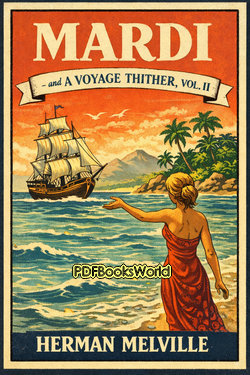
Mardi - and A Voyage Thither, Vol. II
by Herman Melville
A Philosophical Voyage Through Symbolic Islands and Human Ideas
Mardi: and A Voyage Thither, Vol. II by Herman Melville continues the extraordinary imaginative journey begun in the first volume, moving even further away from conventional adventure into allegory, philosophical reflection, satire, and symbolic exploration. The wandering travelers cross island after island within the mysterious world of Mardi, encountering societies and rulers that reflect different political systems, religions, moral beliefs, and human illusions.
The novel becomes less a physical voyage than an intellectual and emotional search through the complexities of civilization and human thought.
The Search for Yillah and the Endless Journey
The narrator continues searching for the elusive Yillah, whose disappearance transforms her into a symbol of lost perfection, beauty, and unattainable idealism.
Alongside companions including Jarl and the philosopher Babbalanja, the travelers move through increasingly strange and symbolic regions of Mardi.
Each island introduces new debates and observations about politics, religion, authority, war, philosophy, and human behavior.
Rather than building toward traditional plot resolution, the novel expands outward into reflection, conversation, satire, and speculative thought.
The search itself gradually becomes more important than any final destination.
The Travelers and Symbolic Figures of Mardi
- The Narrator
A restless seeker moving through emotional longing and philosophical uncertainty. - Yillah
A symbolic figure representing purity, beauty, and impossible desire. - Babbalanja
A philosophical thinker whose reflections shape much of the novel’s intellectual exploration. - Jarl and the Other Wanderers
Companions representing different attitudes toward experience, belief, and reality.
The characters increasingly function as embodiments of ideas as much as individuals.
A World Built From Allegory and Satire
Volume II deepens Melville’s use of allegorical storytelling. Many of the islands and rulers encountered by the travelers symbolize real-world political systems, religious institutions, and philosophical positions.
Melville critiques imperial ambition, organized religion, social hypocrisy, nationalism, and human vanity through imaginative and often humorous encounters.
The tone shifts constantly between poetic beauty, satire, melancholy, and intellectual debate.
This instability gives the novel its strange dreamlike quality.
Major Themes Running Through the Volume
- The Endless Search for Meaning
The travelers continue seeking truth, fulfillment, and emotional certainty in a world filled with ambiguity. - Idealism and Loss
Yillah’s absence symbolizes the human longing for unattainable perfection. - Political and Religious Criticism
Melville questions systems of power, belief, and social organization. - Human Uncertainty
The novel repeatedly suggests that absolute truth may remain unreachable.
Melville’s Most Ambitious Early Experiment
Mardi represents one of Melville’s boldest literary risks. By the second volume, he fully abandons the realistic travel-adventure style that had first brought him popularity.
Instead, he creates a sprawling symbolic universe combining philosophy, satire, fantasy, poetic meditation, and social criticism. The novel anticipates the intellectual ambition and stylistic experimentation later seen in Moby-Dick.
Its unusual structure continues challenging readers while also rewarding close reflection and imaginative engagement.
Why the Novel Still Captivates Curious Readers
Modern readers continue returning to Mardi because few novels feel so boldly unconcerned with conventional storytelling. Melville transforms the voyage narrative into a meditation on belief, desire, civilization, and the limits of human understanding.
The novel also feels strikingly modern in its fragmentation, ambiguity, and skepticism toward fixed truths and stable systems.
For readers interested in philosophical fiction, literary experimentation, symbolic fantasy, and ambitious nineteenth-century literature, this work remains strange, visionary, and unforgettable.
Similar Genres
About the Author

Herman Melville stands among the greatest voices in American literature, celebrated for novels that combine thrilling adventures with profound reflections on humanity, nature, and destiny. Born in New York City in 1819, Melville spent several years at sea, experiences that became the foundation of many of his most memorable works. Explore Herman Melville books to discover the author's life, literary career, and access notable works, including Moby Dick or The Whale, Israel Potter - His Fifty Years of Exile, John Marr and Other Sailors, Mardi - and A Voyage Thither, Vol. I , and more.