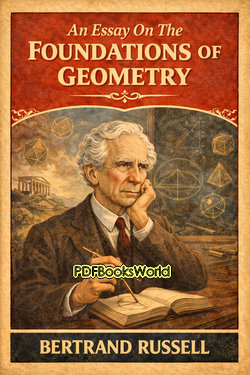
An Essay On The Foundations Of Geometry
by Bertrand Russell
Space, Logic, and the Philosophical Meaning of Geometry
An Essay on the Foundations of Geometry by Bertrand Russell is an important early philosophical work examining the logical, mathematical, and epistemological foundations of geometry. Written during a period of major transformation in mathematics and philosophy, the book investigates how humans understand space, spatial relations, and geometric truth.
Russell combines mathematical reasoning with philosophical analysis, seeking to clarify whether geometry describes objective reality, mental structure, or logical abstraction.
A Philosophical Inquiry Into Space and Mathematics
The book emerged during a time when discoveries in non-Euclidean geometry challenged traditional assumptions about space and mathematical certainty. For centuries, Euclidean geometry had been treated as the unquestioned framework for understanding physical space.
Russell explores how alternative geometrical systems forced philosophers and mathematicians to reconsider the relationship between mathematics and reality itself.
He investigates whether geometric principles are discovered through experience, imposed by the mind, or derived through pure logic.
The work also examines the ideas of earlier philosophers and mathematicians who shaped debates surrounding space, perception, and knowledge.
Russell’s analysis reflects his growing commitment to logical precision and scientific rigor within philosophy.
The Intellectual Questions Explored Within the Book
- Geometry and Spatial Reality: Russell examines whether geometry describes the physical world or abstract logical systems.
- Euclidean and Non-Euclidean Geometry: Competing geometrical models challenge traditional assumptions about certainty and space.
- Logic and Mathematical Structure: The book explores how logical analysis clarifies mathematical concepts and relationships.
- Perception and Human Knowledge: Russell investigates how human beings understand space through experience and reasoning.
The work helped position Russell within the emerging traditions of modern analytic philosophy and mathematical logic.
Can Mathematics Reveal Objective Truth?
One of the book’s strongest concerns is whether mathematical systems describe reality itself or merely provide internally consistent conceptual frameworks. Russell examines the tension between empirical observation and abstract logical reasoning.
The rise of non-Euclidean geometry especially challenged older beliefs that geometry represented self-evident truth about the physical universe.
Russell argues that philosophical clarity requires careful examination of assumptions hidden within both mathematics and perception.
This analytical approach became central to much of his later philosophical work.
Russell’s Early Analytical Philosophy
An Essay on the Foundations of Geometry demonstrates Bertrand Russell’s early development as a philosopher deeply interested in logic, mathematics, and scientific method. Although more technical than many of his later works, the book reveals the intellectual foundations of his later contributions to analytic philosophy.
Russell writes with impressive rigor while engaging with difficult abstract questions about knowledge and reality.
The work reflects his effort to bring precision and logical discipline into philosophical inquiry.
Why the Book Still Matters
Modern readers continue finding An Essay on the Foundations of Geometry historically and philosophically important because it captures a transformative moment in the history of mathematics and philosophy.
The questions Russell explores concerning space, logic, abstraction, and human knowledge continue influencing philosophy of mathematics, physics, epistemology, and analytic thought today.
For readers interested in philosophy of mathematics, geometry, logic, epistemology, and the intellectual origins of modern analytic philosophy, this work remains challenging, foundational, and deeply significant.
Similar Genres
About the Author
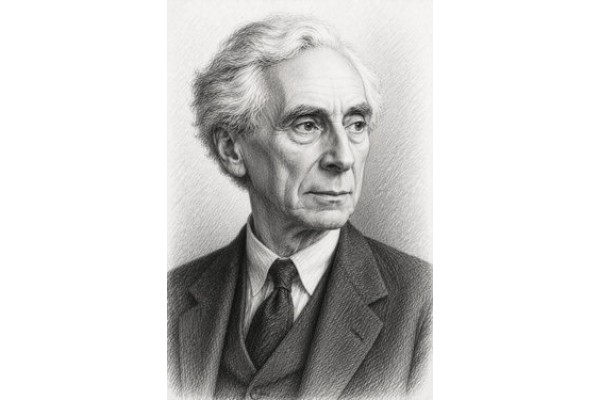
Bertrand Russell was one of the twentieth century's most influential philosophers, mathematicians, and public intellectuals. Born in Wales in 1872, he devoted his life to the pursuit of knowledge, using clear reasoning and careful analysis to examine some of humanity's most important questions. Explore Bertrand Russell books to discover the author's life, literary career, and access notable works, including Mysticism and Logic and Other Essays, The Problems of Philosophy, The Analysis of Mind, Proposed Roads to Freedom , and more.