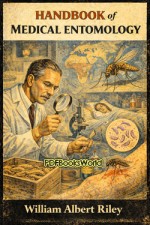
William Albert Riley
William Albert Riley was an American entomologist, educator, and author whose work made important contributions to the study of insects and their relationship to human health. As a professor and researcher, he devoted many years to teaching biology and entomology while encouraging scientific observation and careful investigation. Riley believed that understanding insects was essential not only for agriculture and natural history but also for preventing the spread of diseases. His writings combined scientific accuracy with practical explanations, making them valuable resources for students, medical professionals, and readers interested in the natural sciences.
Advancing the Study of Medical Entomology
William Albert Riley recognized that many insects play a significant role in transmitting diseases to humans and animals. Through his research and teaching, he explained how mosquitoes, flies, fleas, lice, ticks, and other organisms could affect public health. His work helped readers understand the life cycles, habits, and identification of these species while emphasizing the importance of prevention and proper sanitation. At a time when scientific knowledge about disease transmission was expanding rapidly, Riley's contributions helped make this information more widely available.
Making Science Practical and Accessible
One of Riley's greatest strengths was his ability to explain scientific subjects in a logical and understandable way. Rather than presenting only technical descriptions, he connected biological knowledge with real-world applications in medicine and public health. His writing encouraged readers to appreciate the importance of observation, accurate identification, and scientific reasoning when studying insects and controlling the diseases they may spread. This practical approach made his books useful for classroom instruction as well as professional reference.
A Teacher Dedicated to Scientific Learning
Throughout his career, Riley believed that education should inspire curiosity and careful thinking. His lectures and publications encouraged students to study nature systematically and to understand the important role insects play in ecosystems as well as in human health. His balanced approach combined research with practical education, helping generations of learners appreciate both the complexity of insect life and the value of scientific investigation. His work remains an important part of the history of entomology and public health education.
Books Worth Exploring
- Handbook of Medical Entomology – A comprehensive guide to insects and other organisms of medical importance.
- Insect Life and Identification – An educational work introducing the classification and characteristics of insects.
- Studies in Economic Entomology – Research examining insects that affect agriculture and public welfare.
- Practical Entomology – A guide to observing, collecting, and studying insect species.
- Educational Papers on Insect Biology – Writings that promote scientific learning through the study of insects.
An Enduring Contribution to Science
William Albert Riley's work continues to be appreciated for its clear explanations, scientific accuracy, and practical value. His contributions helped strengthen the field of medical entomology by connecting the study of insects with public health and disease prevention. Although scientific knowledge has advanced considerably since his time, his writings remain valuable historical references that reflect the development of modern biological and medical research.
Readers interested in entomology, public health, and the history of medical science can explore the works of William Albert Riley at PDF Books World and discover the lasting contributions of a scientist whose research helped deepen our understanding of insects and their importance to human health.