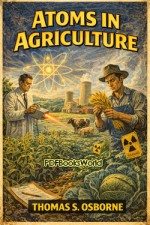
Thomas S. Osborne
Thomas S. Osborne was an American scientist, educator, and author whose writings reflected the growing relationship between scientific research and modern agriculture during the twentieth century. He believed that advances in science could improve farming practices, increase food production, and promote the responsible use of natural resources. Through his educational work, Osborne sought to explain scientific developments in language that could be understood by students, farmers, and general readers alike. His books helped bridge the gap between laboratory research and practical agriculture, demonstrating how scientific discoveries could contribute to more productive and sustainable farming.
Promoting Science in Agriculture
Thomas S. Osborne recognized that agriculture was changing rapidly as new scientific discoveries transformed traditional farming methods. He encouraged readers to understand how chemistry, biology, and physics could improve crop production, livestock management, and soil conservation. Rather than presenting science as an abstract subject, he explained how research could solve practical agricultural problems and support the growing demand for food. His work reflected an optimistic belief that scientific innovation could benefit both farmers and society as a whole.
Making Complex Ideas Easy to Understand
One of Osborne's greatest strengths as an author was his ability to explain technical subjects in a clear and accessible manner. He avoided unnecessary scientific jargon whenever possible, choosing practical examples that demonstrated how modern research influenced everyday farming. His writing encouraged readers to appreciate the value of experimentation, observation, and evidence-based decision-making. This educational approach made his books useful not only for agricultural professionals but also for students and anyone interested in the scientific foundations of food production.
Exploring New Technologies in Farming
During Osborne's lifetime, agriculture entered an era of rapid technological advancement. Scientific tools, improved crop varieties, and new methods of research opened opportunities to increase efficiency while addressing challenges such as pests, soil fertility, and crop yields. Osborne's work introduced readers to these emerging developments, encouraging thoughtful consideration of both their possibilities and their responsible application. Although agricultural science has continued to evolve, his writing captures an important period when modern scientific research was beginning to reshape farming around the world.
An Informative Study of Science and Farming
Atoms in Agriculture is Thomas S. Osborne's best-known work. The book explores how developments in atomic science and related research contributed to agricultural studies during the mid-twentieth century. It explains how scientific techniques could be applied to crop improvement, soil research, plant nutrition, and pest management while highlighting the broader relationship between scientific innovation and food production. Combining practical explanations with scientific insight, the book offers readers an interesting look at a transformative period in agricultural research.
An Enduring Educational Contribution
Thomas S. Osborne's writings continue to illustrate the importance of connecting scientific knowledge with practical applications. His work encouraged readers to view agriculture as a field that benefits from continuous research, innovation, and careful stewardship of natural resources. By presenting scientific ideas in an understandable and engaging way, he helped promote greater appreciation for the role of research in feeding growing populations and improving farming practices. His educational contributions remain valuable for readers interested in the history of agricultural science and the continuing partnership between research and cultivation.
Readers interested in agricultural science, farming history, scientific innovation, and rural education can explore Atoms in Agriculture at PDF Books World and discover an informative work that highlights the growing role of science in shaping the future of agriculture.