
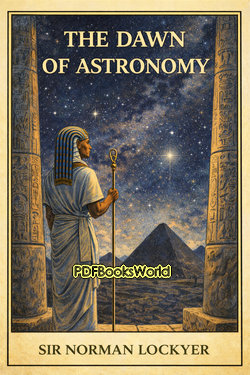
The dawn of astronomy
by Sir Norman Lockyer
Ancient Egypt and the Astronomical Origins of Religion
The dawn of astronomy by Sir Norman Lockyer is an influential historical and scientific study examining the relationship between astronomy, ancient religion, and early civilization, particularly within ancient Egypt. Combining archaeology, astronomy, mythology, and historical analysis, Lockyer investigates how celestial observation shaped temples, calendars, rituals, and religious beliefs in the ancient world.
The work presents astronomy not merely as scientific measurement, but as one of humanity’s earliest intellectual achievements deeply connected with culture, spirituality, and political organization.
Astronomy in Ancient Egypt
Lockyer focuses heavily upon the astronomical knowledge of the ancient Egyptians, arguing that many temples and monuments were deliberately aligned with the rising or setting positions of stars and the Sun. These alignments served religious, ceremonial, and calendrical purposes while reflecting careful long-term observation of the heavens.
The book explores how Egyptian priests and astronomers used celestial events to organize agriculture, religious festivals, and state authority. Solar worship, star observation, and seasonal cycles became central elements of Egyptian civilization.
Rather than separating religion and science completely, Lockyer argues that early astronomy developed directly from humanity’s attempt to understand cosmic order and natural cycles.
Temples, Stars, and Sacred Architecture
A major theme throughout the work is the connection between architecture and celestial observation. Lockyer examines temple orientation, sacred symbolism, and ritual practices associated with specific stars, solstices, and solar events.
The book also reflects nineteenth-century fascination with archaeology and comparative religion during a period of expanding knowledge concerning ancient civilizations. Lockyer attempts to combine scientific methods with historical interpretation in order to reconstruct ancient systems of belief and observation.
At the same time, the work explores how astronomical knowledge influenced mythology, kingship, and cultural identity.
This combination of science and historical investigation gives the book lasting intellectual significance.
Historical and Scientific Themes Explored Throughout the Book
- Astronomy and Religion: Celestial observation shaped ancient spiritual beliefs and rituals.
- Ancient Egyptian Civilization: Astronomy influenced calendars, temples, and political organization.
- Sacred Architecture: Buildings were aligned with solar and stellar events.
- The Origins of Scientific Observation: Early civilizations developed systematic study of the heavens.
- Mythology and Cosmic Order: Religious systems reflected humanity’s attempt to understand nature and time.
Sir Norman Lockyer’s Analytical Style
The dawn of astronomy demonstrates Sir Norman Lockyer’s effort to combine scientific reasoning with archaeological and historical interpretation. His writing remains scholarly, detailed, and strongly focused upon uncovering connections between ancient culture and astronomical knowledge.
Lockyer consistently presents astronomy as one of the foundational forces shaping human civilization.
Why the Book Still Holds Historical and Scientific Interest
Modern readers continue finding The dawn of astronomy valuable because its themes of astronomy, ancient religion, archaeology, and scientific history remain highly relevant in interdisciplinary historical studies. The work also contributed significantly to early discussions concerning archaeoastronomy and the role of celestial observation in ancient cultures.
Its themes of science, mythology, ancient Egypt, architecture, and cultural development continue appealing to readers interested in astronomy, archaeology, religious history, and the origins of scientific thought.
Similar Genres
About the Author
Sir Norman Lockyer was an English astronomer, physicist, science writer, and one of the pioneers of modern astrophysics. Best known for his discovery of helium through solar spectroscopy before the element was identified on Earth, Lockyer transformed the study of astronomy by applying the principles of physics to the investigation of celestial bodies. Explore Sir Norman Lockyer books to discover the author's life, literary career, and access notable works.