
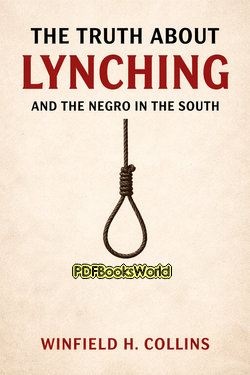
The Truth About Lynching and the Negro in the South
by Winfield H. Collins
A Controversial Historical Work Reflecting Early Twentieth-Century Racial Attitudes
The Truth About Lynching and the Negro in the South by Winfield H. Collins is a controversial nonfiction work published during a period of intense racial conflict in the United States. The book addresses issues of race relations, lynching, crime, and social conditions in the American South. Today, it is primarily studied as a historical document because many of its arguments reflect the racial assumptions, biases, and social attitudes that were common among some writers of its era.
Modern readers often approach the work not as an authoritative source on race relations, but as evidence of how certain viewpoints were expressed and defended during the early twentieth century. The book provides insight into the debates, prejudices, and political tensions that shaped public discourse during that period.
Historical Context
The book was written during the Jim Crow era, a time when segregation laws and racial discrimination were widespread across much of the Southern United States. Questions surrounding civil rights, political participation, education, and racial violence were central issues in American society.
Collins presents his interpretation of these matters, attempting to explain social conditions and racial tensions as he understood them. His conclusions reflect the perspectives of his time and should be read with awareness of the broader historical context in which they were produced.
Lynching as a Subject of Debate
A major focus of the book is the subject of lynching, one of the most troubling aspects of American history. Lynchings were extrajudicial acts of violence that claimed thousands of lives, particularly those of African Americans. Collins discusses the issue extensively, offering explanations and arguments that have since been challenged and criticized by historians and civil rights scholars.
The book therefore serves as a source for understanding how some contemporaries attempted to justify or interpret events that are now widely recognized as serious violations of justice and human rights.
Highlights of the Work
- Historical Perspective: A view of race relations from the early twentieth century.
- Social Commentary: Discussion of Southern society and public issues.
- Political Context: Reflection of debates occurring during the Jim Crow era.
- Controversial Arguments: Positions that have generated significant criticism.
- Historical Value: Useful for studying attitudes and beliefs of the period.
Major Themes
- Race Relations: Discussions of social and political divisions.
- Justice: Debates concerning law, order, and public violence.
- Public Opinion: How social attitudes shape policy and behavior.
- Historical Interpretation: Competing explanations of social problems.
- Cultural Change: The evolving understanding of civil rights and equality.
Reading the Book Today
Modern scholarship has greatly expanded knowledge of the history of lynching, racial violence, and African American life. As a result, contemporary readers often examine Collins's work critically, comparing its claims with later historical research and evidence.
The book can therefore be valuable as a primary source that reveals how certain ideas were presented during its era, rather than as a definitive account of the subjects it discusses.
Why the Book Remains Historically Significant
The Truth About Lynching and the Negro in the South remains significant because it offers insight into the social and intellectual climate of the early twentieth-century South. While its arguments are controversial and frequently disputed by modern historians, the work provides a window into the attitudes and debates that influenced public discussion during a pivotal period in American history.
For readers interested in American history, race relations, civil rights history, and historical sources, the book serves as an important example of how controversial social issues were interpreted and debated in its time. Its greatest value today lies in helping readers understand the historical context from which later struggles for equality and justice emerged.
Similar Genres
About the Author
Winfield H. Collins was an American writer, historian, and social commentator whose work focused on the political, historical, and social issues of the United States during the late nineteenth and early twentieth centuries. He examined topics that were often controversial, encouraging readers to consider historical events and public debates through detailed analysis and documented evidence. Explore Winfield H. Collins books to discover the author's life, literary career, and access notable works.