
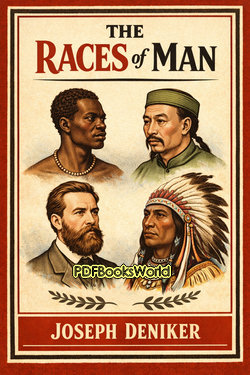
The Races of Man
by Joseph Deniker
Exploring Humanity Through Early Anthropology and Cultural Study
The Races of Man: An Outline of Anthropology and Ethnography by Joseph Deniker is an ambitious historical study that examines human diversity, cultural traditions, physical anthropology, and the development of civilizations around the world. Written during a period when anthropology was emerging as a formal academic discipline, the book reflects the scientific curiosity and global exploration that shaped nineteenth-century social science.
Deniker combines geography, biology, sociology, and ethnographic observation in an effort to understand how human societies developed across different regions and environments. Although many theories from that period have since changed, the book remains historically important as a record of early anthropological thinking.
The Rise of Anthropology as a Science
During the nineteenth century, scholars increasingly attempted to study humanity through scientific methods. Anthropology focused on human origins, physical characteristics, language, migration, and cultural development, while ethnography examined customs, traditions, beliefs, and everyday life among different populations.
The Races of Man was written during this intellectual movement, when researchers were collecting information from around the world in an attempt to create broad classifications of human societies.
Deniker sought to organize this knowledge systematically, reflecting the academic interests of his era.
Topics Explored Throughout the Book
The book examines a wide range of subjects related to human civilization and cultural diversity.
- Human populations and physical characteristics
- Languages, traditions, and social customs
- The influence of geography on civilization
- Migration and cultural development across regions
These discussions reveal how early anthropologists attempted to explain the variety of human societies throughout the world.
A Historical Perspective on Anthropology
Modern readers often approach the book as a historical document rather than a guide to current scientific understanding. Many racial theories and classification systems used during Deniker’s time are now considered outdated by modern anthropology.
Contemporary researchers emphasize the complexity of culture, shared human origins, and the limitations of rigid racial categorization. Scientific understanding of genetics and human diversity has changed significantly since the book was first published.
Even so, the work remains valuable because it helps readers understand how anthropology evolved as a field of study and how scholars of the past attempted to explain human civilization.
The Global Scope of the Work
One of the book’s most interesting qualities is its broad international perspective. Deniker discusses societies from Europe, Asia, Africa, the Americas, and other regions, attempting to compare cultures, customs, and historical development.
The work reflects a period when European scholars were increasingly interested in global exploration and comparative cultural research. This worldwide scope gives the book historical significance within the development of social science.
The Writing Style of Joseph Deniker
Deniker writes in a formal and analytical style typical of academic works from the late nineteenth century. His explanations are detailed and systematic, reflecting the scientific ambitions of early anthropology.
Although some sections may appear technical for modern readers, the book remains readable for those interested in history, anthropology, and the development of scientific ideas.
The combination of cultural observation and historical analysis gives the work lasting intellectual interest.
Why The Races of Man Still Matters
The Races of Man continues to hold value as a historical study of anthropology and ethnography. It offers insight into how earlier generations attempted to understand human diversity, social development, and global civilization.
For readers interested in anthropology, intellectual history, and the evolution of scientific thought, Joseph Deniker’s work remains an important example of early efforts to study humanity on a worldwide scale.
Similar Genres
About the Author
Joseph Deniker was a French anthropologist, naturalist, and librarian who made significant contributions to the study of human diversity during the late nineteenth and early twentieth centuries. He devoted much of his career to understanding the physical characteristics, origins, and distribution of human populations around the world. Explore Joseph Deniker books to discover the author's life, literary career, and access notable works.