
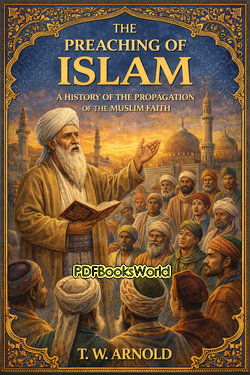
The Preaching of Islam
by T. W. Arnold
A Scholarly Study of the Spread of Islam Across the World
The Preaching of Islam by T. W. Arnold is one of the most influential historical studies examining how Islam spread across different regions and cultures. First published in the late nineteenth century, the book explores the methods, circumstances, and historical processes through which Islamic beliefs reached diverse populations throughout Asia, Africa, Europe, and beyond. Arnold approaches the subject as a historian, seeking to understand the social, political, cultural, and religious factors that contributed to the growth of Islam over many centuries.
Rather than focusing solely on military or political events, the work pays significant attention to missionaries, scholars, merchants, travelers, and community leaders who helped introduce Islamic teachings to new audiences. The book remains an important resource for readers interested in religious history, cultural exchange, and the development of world civilizations.
The Purpose of the Study
Arnold wrote the book to examine a question that had long attracted scholarly interest: how did Islam spread so widely across different societies? To answer this, he investigated historical records from numerous regions and periods, analyzing the various ways people encountered and adopted Islamic beliefs.
The author emphasizes that the spread of a religion is often a complex process influenced by many factors. Economic connections, educational institutions, personal relationships, trade networks, and cultural interactions all played roles in shaping the historical development of Islamic communities.
Islam Beyond Borders
One of the most striking aspects of the book is its global perspective. Arnold traces the expansion of Islam across a vast geographical area, demonstrating how the religion adapted to different cultures while maintaining core principles. From the Middle East to South Asia, Southeast Asia, Africa, and parts of Europe, the book highlights the diversity of Muslim societies and their historical experiences.
This broad approach allows readers to appreciate the international character of Islamic civilization and the many pathways through which ideas and traditions traveled between communities.
Key Subjects Covered in the Book
- Religious History: The development and expansion of Islamic communities.
- Missionary Activity: The role of teachers, scholars, and preachers.
- Trade and Commerce: How commercial networks facilitated cultural exchange.
- Regional Studies: Historical accounts from Asia, Africa, and other regions.
- Cultural Interaction: Encounters between different societies and traditions.
The Role of Trade and Learning
Arnold places considerable emphasis on the influence of merchants and scholars. Trade routes connected distant regions, enabling not only the exchange of goods but also the movement of ideas. In many areas, merchants introduced Islamic beliefs through daily interactions and long-term relationships with local communities.
Educational institutions and centers of learning also contributed to the religion's spread. Scholars, teachers, and students traveled widely, helping preserve and transmit religious knowledge across generations and geographical boundaries.
Major Themes in the Work
- Cultural Exchange: Ideas often spread through interaction between communities.
- Education: Learning plays a central role in preserving and sharing traditions.
- Historical Diversity: Islamic societies developed in many different cultural settings.
- Communication: Trade and travel helped connect distant populations.
- Religious Development: Faith traditions evolve through historical experience.
Arnold's Historical Approach
T. W. Arnold was known for his careful use of historical sources and his interest in understanding religious history through evidence and analysis. His work reflects an effort to move beyond simple explanations and examine the many influences that shaped historical events.
By drawing upon records from multiple regions, he presents a detailed picture of how Islam expanded over time. His emphasis on cultural and social factors helped make the book a significant contribution to the study of religious history.
Why the Book Remains Important
The Preaching of Islam continues to be valued by historians, students, and general readers because it provides a comprehensive examination of one of the world's major religious traditions and its historical growth. While modern scholarship has expanded upon many of Arnold's findings, the book remains a foundational study in the field.
For readers interested in world history, religious studies, cultural interaction, and the development of civilizations, the work offers valuable insights into the complex processes through which ideas spread across societies. Its broad perspective and detailed research ensure its continuing relevance as a significant historical resource.
Similar Genres
About the Author
Thomas Walker Arnold, widely known as T. W. Arnold, was an English historian, orientalist, educator, and scholar whose research greatly advanced the academic study of Islam and its history. Explore T. W. Arnold books to discover the author's life, literary career, and access notable works.