
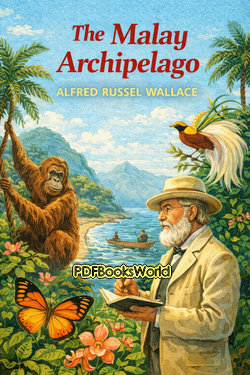
The Malay Archipelago: Exploration, Nature, and Scientific Discovery
Author: Alfred Russel Wallace
Part travel adventure, part scientific study, and part cultural observation, The Malay Archipelago is one of the great exploration books of the 19th century. In this remarkable work, Alfred Russel Wallace documents his journeys across Southeast Asia while studying wildlife, geography, and local cultures.
The book became famous not only for its exciting travel experiences but also for its important contributions to evolutionary science and natural history.
Journey Across a Vast Island World
Wallace traveled for years through regions that now include parts of:
- Indonesia
- Malaysia
- Singapore
- Papua New Guinea
During these journeys, he crossed jungles, mountains, rivers, and remote islands while collecting thousands of animal specimens and recording observations about nature and human societies.
What Makes the Book Unique?
Adventure Writing
The narrative contains storms, dangerous travel, difficult terrain, tropical diseases, and encounters with unfamiliar wildlife.
Scientific Observation
Wallace carefully studies birds, insects, mammals, and plant life while comparing species across different islands.
Cultural Encounters
The book also includes descriptions of local customs, trade, languages, and daily life among different communities.
The Famous “Wallace Line”
One of the book’s most important scientific ideas involves the discovery later called the Wallace Line.
Wallace noticed that animal species changed dramatically between certain islands even when the distances between them were small.
This observation helped scientists better understand:
- Animal distribution
- Geography and evolution
- Species adaptation
- The separation of ecosystems
His discoveries became highly important in the development of evolutionary biology.
Main Themes Throughout the Book
| Theme | Description |
| Exploration | The excitement and danger of discovering unfamiliar regions. |
| Nature and Science | Careful observation of wildlife and natural systems. |
| Cultural Curiosity | Interest in local traditions and societies. |
| Human Endurance | Survival through illness, weather, and difficult travel conditions. |
Wallace’s Writing Style
Alfred Russel Wallace writes with a balance of scientific precision and adventurous storytelling.
His style includes:
- Detailed nature descriptions
- Personal travel experiences
- Clear scientific explanation
- Curiosity and enthusiasm
- Observational realism
The combination makes the book informative while still highly readable and engaging.
Why the Book Still Matters
Even today, The Malay Archipelago remains important because it combines scientific discovery with firsthand exploration.
Modern readers continue to value the book for its:
✔ Historical importance in science
✔ Descriptions of tropical biodiversity
✔ Exploration narrative
✔ Insight into 19th-century travel
✔ Contribution to evolutionary theory
More Than a Science Book
Although scientifically significant, the work is also a vivid portrait of travel and human curiosity. Wallace’s excitement about discovering unfamiliar landscapes and species gives the narrative energy and personality.
The book captures a period when large parts of the world still felt mysterious to European explorers and naturalists.
Ideal Readers for This Classic
This book is especially recommended for readers interested in:
Natural history, evolution, exploration literature, tropical wildlife, geography, anthropology, and scientific travel writing.
Final Thoughts
The Malay Archipelago by Alfred Russel Wallace remains one of the great classics of exploration and scientific literature. Through adventurous travel and groundbreaking observation, Wallace reveals the extraordinary natural diversity of Southeast Asia while helping shape modern ideas about evolution and biodiversity.
Educational, adventurous, and historically important, the book continues to inspire readers fascinated by discovery and the natural world.