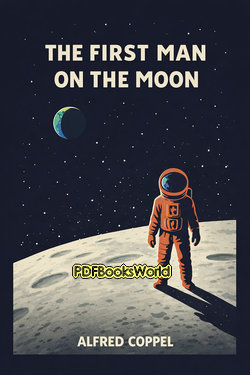
The First Man On the Moon
by Alfred Coppel
Space Exploration, Heroic Risk, and Humanity’s First Journey Beyond Earth
The First Man On the Moon by Alfred Coppel is a science fiction adventure exploring lunar travel, technological ambition, survival, and the psychological pressures of humanity’s attempt to reach another world. Written during the era of classic speculative fiction, the story reflects mid-twentieth-century fascination with space exploration and the belief that scientific achievement could soon carry humanity beyond Earth’s boundaries.
Coppel presents the Moon not merely as a distant celestial object, but as a dangerous and mysterious frontier testing human courage, ingenuity, and endurance under extreme conditions.
The Challenge of Reaching the Moon
The story follows the perilous effort to achieve the first successful human landing upon the lunar surface. The mission involves advanced technology, physical danger, and enormous uncertainty as explorers attempt to survive the hostile environment of outer space and the Moon itself.
As the narrative unfolds, the journey becomes not only a scientific achievement, but also an emotional and psychological trial shaped by isolation, fear, and the constant possibility of disaster.
Rather than portraying space travel as effortless triumph, the work emphasizes the fragility of human life within the unforgiving conditions beyond Earth.
The volume reflects the intense public imagination surrounding rockets, astronauts, and future space programs during the years before actual lunar missions became reality.
Its tone combines suspense, technological excitement, and speculative realism.
The Human Cost of Exploration
A major theme throughout the story is that great scientific achievements require enormous personal sacrifice and emotional resilience.
Coppel repeatedly explores the psychological strain placed upon individuals confronting isolation, danger, and the unknown while carrying humanity’s hopes into unexplored territory.
The work also reflects broader twentieth-century fascination with pioneers who challenge physical and intellectual boundaries despite overwhelming risk.
This focus on courage and vulnerability gives the narrative much of its emotional power.
Science Fiction Themes Explored Throughout the Story
- Space Travel and Lunar Exploration: Humanity attempts its first dangerous journey to the Moon.
- Technology and Scientific Ambition: Advanced engineering becomes the pathway toward interplanetary exploration.
- Survival in Hostile Environments: Space and the lunar surface create constant physical danger.
- Psychological Isolation and Fear: Characters endure emotional pressure and uncertainty far from Earth.
- The Spirit of Human Discovery: Exploration symbolizes humanity’s desire to push beyond known limits.
The story reflects many defining characteristics of classic pre-space-age science fiction adventure.
The Moon as Humanity’s Next Frontier
One of the work’s strongest ideas is that exploration of space represents both extraordinary human achievement and confrontation with forces vastly greater than humanity itself.
Coppel repeatedly demonstrates how courage, intelligence, and determination become essential when entering environments where ordinary human experience offers little preparation.
The story also reveals mid-century optimism and anxiety surrounding the approaching age of real-world space exploration.
This combination of scientific excitement and existential danger gives the narrative lasting speculative appeal.
Alfred Coppel’s Fast-Paced Speculative Style
The First Man On the Moon demonstrates Alfred Coppel’s ability to combine technological imagination, suspenseful pacing, and emotional tension into compelling science fiction adventure.
The writing remains vivid, energetic, and strongly focused upon maintaining danger, urgency, and awe surrounding humanity’s first steps into space.
Coppel consistently presents scientific progress as both thrilling achievement and profound test of human endurance.
Why the Story Still Holds Science Fiction Interest
Modern readers continue finding The First Man On the Moon fascinating because it captures the anticipation and imaginative excitement surrounding lunar exploration before humanity actually reached the Moon.
The story also provides insight into mid-twentieth-century hopes and fears regarding rockets, astronauts, scientific progress, and the future of space travel during the early years of the space age imagination.
Its themes of exploration, survival, technological ambition, and human courage continue appealing to readers who enjoy classic speculative adventure fiction.
For readers interested in science fiction, lunar exploration, space travel stories, astronaut adventures, speculative technology, and classic pulp-era futurism, this work remains exciting, imaginative, and historically intriguing.
Similar Genres
About the Author

Alfred Coppel was an American novelist and short story writer whose imaginative fiction blended science fiction, military adventure, and suspense with remarkable technical realism. Born in New York City in 1921, Coppel served as a fighter pilot during the Second World War, an experience that profoundly influenced his writing. Explore Alfred Coppel books to discover the author's life, literary career, and access notable works, including Flight From Time, The Last Two Alive!, Warrior-Maid of Mars, Runaway , and more.