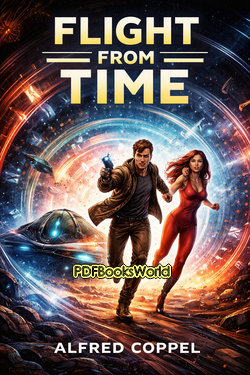
Flight From Time
by Alfred Coppel
Time Travel, Historical Catastrophe, and the Struggle to Escape Destiny
Flight From Time by Alfred Coppel is a science fiction story combining time travel, danger, historical disruption, and survival against forces that threaten both individual lives and the stability of history itself. Written during the golden age of speculative fiction, the story reflects mid-twentieth-century fascination with temporal paradoxes, advanced technology, and the consequences of interfering with time.
Coppel presents time travel not as a harmless scientific achievement, but as a dangerous force capable of trapping human beings between eras, altering reality, and placing civilization itself at risk.
The Dangers of Moving Through Time
The story follows characters caught within extraordinary circumstances involving travel across different periods of history. As events unfold, they confront the unpredictable effects of temporal displacement and the terrifying possibility that changes made in one era may reshape the future in irreversible ways.
The characters must rely upon intelligence, courage, and scientific understanding while attempting to survive forces beyond ordinary human control.
Rather than portraying time travel as simple adventure alone, the work emphasizes confusion, instability, and the psychological strain created by movement outside normal chronology.
The volume reflects the era’s fascination with scientific breakthroughs and the fear that advanced technology might exceed humanity’s ability to control it safely.
Its tone combines suspense, urgency, and speculative imagination.
The Fragility of History and Human Existence
A major theme throughout the story is that history may be more vulnerable and unstable than humanity assumes.
Coppel repeatedly explores the idea that even small disruptions in time can create enormous consequences affecting societies, individuals, and future events.
The work also reflects broader science fiction concerns regarding destiny, causality, and humanity’s limited understanding of the forces governing reality.
This tension between scientific possibility and catastrophic danger gives the narrative much of its dramatic power.
Science Fiction Themes Explored Throughout the Story
- Time Travel and Temporal Instability: Characters confront the dangers created by movement across history.
- Scientific Power and Human Limitation: Advanced technology threatens consequences beyond human control.
- Historical Change and Causality: Alterations to events may reshape reality and the future.
- Survival Under Extraordinary Conditions: Fear, uncertainty, and danger test human endurance and judgment.
- The Mystery of Time: The story explores humanity’s incomplete understanding of temporal reality.
The story reflects many classic themes associated with mid-century speculative science fiction.
The Fear of Technological Overreach
One of the work’s strongest ideas is that scientific advancement without sufficient wisdom may produce disastrous and uncontrollable effects.
Coppel repeatedly demonstrates how curiosity and experimentation can place individuals in situations where ordinary laws of reality no longer offer safety or certainty.
The story also reveals postwar fascination with scientific progress combined with anxiety concerning humanity’s ability to manage powerful discoveries responsibly.
This combination of scientific imagination and existential danger gives the story enduring appeal.
Alfred Coppel’s Fast-Paced Speculative Style
Flight From Time demonstrates Alfred Coppel’s ability to combine scientific speculation, suspense, and rapid storytelling into an engaging science fiction narrative.
The writing remains energetic, tense, and strongly focused upon maintaining danger and momentum while exploring imaginative technological concepts.
Coppel consistently presents the universe as a place where scientific ambition may lead to both discovery and catastrophe.
Why the Story Still Holds Science Fiction Interest
Modern readers continue finding Flight From Time entertaining because it captures the adventurous spirit and speculative excitement of classic pulp-era science fiction while exploring enduring questions about time, causality, and technological risk.
The story also provides insight into mid-twentieth-century attitudes toward science, progress, and the uncertainties surrounding humanity’s rapidly expanding technological power.
Its themes of temporal danger, survival, paradox, and historical instability continue appealing to readers who enjoy classic time-travel adventures and speculative fiction.
For readers interested in science fiction, time travel stories, speculative technology, pulp adventures, temporal paradoxes, and classic futuristic literature, this work remains imaginative, suspenseful, and intellectually engaging.
Similar Genres
About the Author

Alfred Coppel was an American novelist and short story writer whose imaginative fiction blended science fiction, military adventure, and suspense with remarkable technical realism. Born in New York City in 1921, Coppel served as a fighter pilot during the Second World War, an experience that profoundly influenced his writing. Explore Alfred Coppel books to discover the author's life, literary career, and access notable works, including The First Man On the Moon, The Last Two Alive!, Warrior-Maid of Mars, Runaway , and more.