
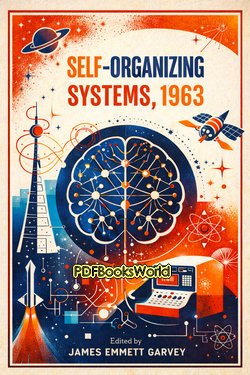
Self-Organizing Systems, 1963
by James Emmett Garvey
An Early Exploration of Complexity, Automation, and Intelligent Systems
Self-Organizing Systems, 1963 by James Emmett Garvey examines one of the most intriguing scientific ideas of the twentieth century: the ability of complex systems to organize themselves without direct external control. Written during a period of rapid advances in computing, cybernetics, and systems theory, the work explores how order can emerge from interactions among simpler components. The book reflects the growing interest in understanding the principles that govern biological organisms, machines, and social systems alike.
The Concept of Self-Organization
Self-organization refers to the process by which a system develops structure, coordination, or patterns through internal interactions rather than centralized direction. Scientists observed that many natural and artificial systems exhibit this behavior, from living cells and ecosystems to communication networks and automated machines.
Garvey introduces readers to these ideas and examines how seemingly complex behavior can arise from relatively simple rules and relationships.
A Scientific World in Transition
The early 1960s witnessed remarkable developments in computing technology and theoretical science. Researchers were beginning to investigate how machines might adapt, learn, and respond to changing conditions. At the same time, biologists, mathematicians, and engineers were searching for common principles that could explain organization across different fields.
The book captures the excitement of this era, when many believed that a deeper understanding of systems could transform science and technology.
Major Topics Discussed
- Cybernetics: The study of control, communication, and feedback in systems.
- Automation: Mechanisms that operate with limited human intervention.
- Complex Systems: Interactions that produce organized behavior.
- Information Theory: The transmission and processing of information.
- Artificial Intelligence: Early ideas about machine learning and adaptive behavior.
The Influence of Cybernetics
Much of the discussion is shaped by the emerging field of cybernetics, which sought to understand how systems maintain stability, adapt to change, and process information. Researchers viewed feedback mechanisms as essential to both biological organisms and mechanical devices.
Garvey explores how these concepts could be applied to increasingly sophisticated technologies and organizational structures.
From Biology to Machines
One of the book's most interesting features is its interdisciplinary perspective. Rather than limiting discussion to a single field, it examines similarities between natural and artificial systems. The behavior of living organisms, social groups, and electronic devices is considered within a shared framework of organization and adaptation.
This broad approach anticipated later developments in complexity science and systems thinking.
Why the Work Remains Relevant
Many of the ideas explored in Self-Organizing Systems, 1963 have become increasingly important in the modern world. Concepts related to artificial intelligence, network theory, machine learning, and complex adaptive systems continue to shape scientific research and technological innovation.
Readers interested in the origins of these fields can gain valuable insight from the questions and theories discussed during this formative period.
A Thought-Provoking Study of Order and Complexity
Self-Organizing Systems, 1963 offers a fascinating introduction to ideas that would later influence numerous scientific and technological disciplines. Through its exploration of automation, cybernetics, and emergent behavior, James Emmett Garvey presents a vision of systems capable of creating order from complexity. The book remains an important historical contribution to the study of organization, intelligence, and the interconnected nature of complex systems.
Similar Genres
About the Author
James Emmett Garvey was an American researcher, editor, and science writer whose work reflected the growing interest in emerging technologies during the mid-twentieth century. He contributed to the communication of complex scientific ideas at a time when fields such as cybernetics, automation, computer science, and systems theory were developing rapidly. Explore James Emmett Garvey books to discover the author's life, literary career, and access notable works.