
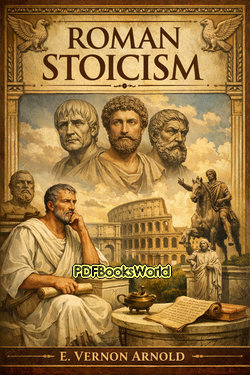
Roman Stoicism
by E. Vernon Arnold
A Scholarly Exploration of Stoic Philosophy in the Roman World
Roman Stoicism by E. Vernon Arnold is a comprehensive study of Stoic philosophy as it developed and influenced intellectual life within the Roman world. The book examines the teachings, ethics, cosmology, and historical importance of Stoicism while tracing how Greek philosophical ideas were adapted by Roman thinkers into a practical system of moral discipline and personal conduct.
Arnold presents Stoicism not merely as an abstract philosophical theory, but as a living ethical tradition shaping politics, education, religion, and everyday life throughout the Roman Empire. The work combines classical scholarship with philosophical analysis and historical interpretation.
The volume blends intellectual history with philosophy and classical studies.
The Development of Roman Stoicism
Stoicism: A philosophical school founded in ancient Greece that taught self-control, rationality, virtue, and acceptance of fate as the path to inner freedom and moral strength.
The book likely discusses major Roman Stoic thinkers such as Seneca, Epictetus, and Marcus Aurelius, examining how they applied Stoic principles to politics, personal conduct, suffering, and public responsibility.
Arnold also explores Stoic ideas concerning nature, reason, ethics, cosmology, and humanity’s place within an ordered universe governed by rational law.
The atmosphere combines scholarly seriousness with admiration for philosophical discipline and moral reflection.
The Scholarly Style of E. Vernon Arnold
E. Vernon Arnold writes in a clear and methodical style emphasizing historical context, philosophical explanation, and careful interpretation of classical sources. His work reflects early twentieth-century classical scholarship devoted to making ancient philosophy accessible to educated readers.
The prose balances intellectual rigor with readable discussion of complex philosophical concepts.
Arnold’s structured analysis gives the work lasting educational value.
Main Themes and Philosophical Reflection
The book explores themes of virtue, reason, self-control, morality, duty, emotional discipline, fate, freedom, nature, ethics, and the pursuit of inner peace.
Through discussion of Stoic thought and Roman intellectual life, the work examines how philosophy can guide human behavior during periods of suffering, uncertainty, and political instability.
Why the Book Still Holds Importance
Roman Stoicism remains valuable because Stoic philosophy continues to influence ethics, psychology, leadership theory, and modern discussions about resilience and self-discipline. Scholars and general readers alike continue to study Stoicism for its practical and philosophical insights.
The book also provides historical understanding of how Roman thinkers transformed Greek philosophy into a powerful ethical tradition.
Its combination of scholarship and philosophical clarity continues to make it significant.
The Lasting Importance of Stoic Philosophy
Stoicism became one of the most influential philosophical systems of the ancient world because it offered practical guidance for living rationally and virtuously under difficult circumstances.
Roman Stoic writers especially emphasized moral duty, emotional restraint, and acceptance of events beyond human control.
The continuing modern revival of Stoic thought helps preserve appreciation for works like this.
Final Thoughts
Roman Stoicism by E. Vernon Arnold is an insightful and scholarly examination of one of the most enduring philosophical traditions of the ancient world. Through historical analysis and philosophical explanation, the book reveals how Stoicism shaped Roman intellectual life and continues to influence modern ideas about ethics, resilience, and personal discipline.
For readers interested in philosophy, classical studies, ethics, and intellectual history, this work remains both intellectually rewarding and historically important.
Similar Genres
About the Author
E. Vernon Arnold was an English classical scholar, educator, and historian whose work helped make the philosophy and literature of the ancient world more accessible to modern readers. As a respected authority on Greek and Roman civilization, Arnold devoted much of his academic career to studying classical philosophy, language, and history. Explore E. Vernon Arnold books to discover the author's life, literary career, and access notable works.