
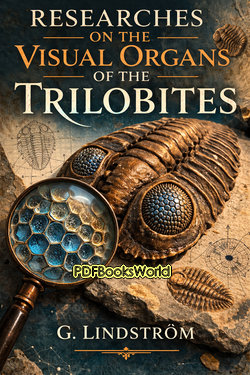
Researches on the Visual Organs of the Trilobites
by Gustaf Lindstrom
Unlocking the Secrets of Ancient Eyes from a Lost World
Researches on the Visual Organs of the Trilobites by Gustaf Lindström is a fascinating scientific study that explores one of the most remarkable features of trilobites, the extinct marine creatures that inhabited Earth's oceans hundreds of millions of years ago. Through detailed observation and analysis, Lindström investigates the structure and function of trilobite eyes, providing valuable insights into the evolution of vision and the history of life on our planet.
The work stands as an important contribution to paleontology, combining careful research with a deep interest in understanding how ancient organisms interacted with their environment.
Why Trilobite Eyes Captured Scientific Interest
Trilobites are among the most well-known fossils discovered by scientists. Their preserved remains offer a wealth of information about prehistoric life, but their visual organs have attracted particular attention because of their complexity. Despite living hundreds of millions of years ago, many trilobite species possessed highly developed eyes capable of detecting their surroundings with remarkable efficiency.
Lindström's research examines fossil evidence to determine how these visual systems were constructed and how they may have functioned in ancient marine environments.
Key Areas Explored in the Study
- Eye Structure: Detailed examination of the physical arrangement of trilobite visual organs.
- Lens Composition: Investigation into the materials that formed the eyes.
- Species Differences: Comparisons between various trilobite groups and their visual adaptations.
- Evolutionary Significance: Analysis of what these features reveal about the development of vision.
These topics help readers understand why trilobite eyes remain an important subject of scientific investigation.
What Fossils Reveal About Ancient Vision
One of the most remarkable aspects of trilobite fossils is the preservation of eye structures that can still be studied today. By examining these fossils, scientists gain clues about how ancient creatures detected movement, navigated their surroundings, and responded to predators or prey.
Lindström's observations demonstrate that even early forms of life developed sophisticated solutions to environmental challenges. The findings highlight the incredible adaptability of living organisms throughout Earth's history.
Scientific Importance of the Research
- Advances Paleontology: Expands knowledge of extinct marine species.
- Supports Evolutionary Studies: Provides evidence for the development of complex biological systems.
- Encourages Comparative Research: Allows scientists to compare ancient and modern visual organs.
- Preserves Historical Knowledge: Documents important fossil observations for future generations.
These contributions have helped make the study a respected reference within the scientific community.
A Careful and Methodical Approach
Gustaf Lindström approached his subject with precision and attention to detail. Rather than relying on speculation, he based his conclusions on observable fossil evidence and careful comparison. This scientific discipline gives the work lasting value, even as new technologies continue to expand our understanding of ancient life.
His research reflects the growing scientific curiosity of the nineteenth century, a period when paleontology was rapidly developing into a modern scientific field.
Why the Work Remains Relevant Today
Researches on the Visual Organs of the Trilobites continues to interest paleontologists, evolutionary biologists, and readers fascinated by prehistoric life. The study demonstrates how fossils can reveal extraordinary details about organisms that disappeared long ago. Through his investigation of trilobite vision, Gustaf Lindström offers a deeper understanding of evolution, adaptation, and the remarkable complexity of life in Earth's distant past.
Similar Genres
About the Author
Gustaf Lindström was a Swedish paleontologist and geologist whose meticulous research greatly advanced the study of ancient marine life and fossil invertebrates. Best known for his investigations of Paleozoic fossils, he made significant contributions to the understanding of trilobites, corals, brachiopods, and other extinct organisms preserved in the geological record. Explore Gustaf Lindstrom books to discover the author's life, literary career, and access notable works.