
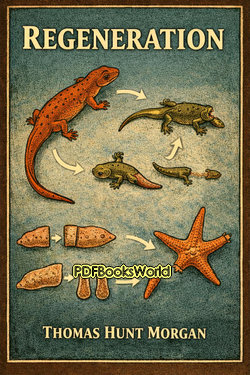
Regeneration
by Thomas Hunt Morgan
When Nature Rebuilds What Has Been Lost
A starfish grows back an arm. A tiny organism survives after being cut into pieces. Certain animals recover damaged body parts in ways that almost seem impossible. In Regeneration, Thomas Hunt Morgan explores these remarkable biological abilities and examines how living creatures repair, replace, and rebuild themselves.
Instead of presenting biology as a collection of dry facts, the book focuses on one fascinating question: how does life restore itself after injury? Through experiments, observations, and scientific discussion, Morgan introduces readers to the surprising regenerative powers found throughout nature.
The work stands as an important example of early experimental biology and reflects a growing scientific effort to understand how living organisms function at their most basic level.
Science Built Around Observation and Experiment
Much of the book centers on laboratory research involving animals capable of regeneration. Morgan explains how scientists observed biological responses after injury and carefully recorded what happened during recovery.
Different organisms showed very different abilities. Some could replace entire body parts, while others recovered only partially. These differences helped researchers investigate deeper questions about growth, development, and the organization of living tissue.
Rather than relying on theory alone, the book repeatedly emphasizes direct experimentation as the foundation of scientific understanding.
Remarkable Biological Processes Discussed in the Book
Regrowth of Lost Structures
The book examines animals capable of replacing limbs, tails, or other damaged body parts.
Cellular Activity and Repair
Morgan discusses how living tissue responds after injury and begins rebuilding itself.
Differences Between Species
Some organisms regenerate easily, while others possess very limited recovery abilities.
The Limits of Regeneration
The author also explores situations where regeneration fails or remains incomplete.
Why the Subject Captured Scientific Attention
At the time the book was written, regeneration research was connected to larger scientific debates about evolution, development, and heredity. Scientists hoped these studies might explain how organisms grow and organize themselves.
The topic attracted attention because it raised difficult biological questions:
- How does the body know what to rebuild?
- Why can some animals regenerate while others cannot?
- What controls growth and repair?
- Can regeneration reveal deeper laws of life?
These questions pushed biology into new areas of research that would later influence genetics and developmental science.
The Writing Balances Curiosity With Scientific Detail
Regeneration is scientific in tone, but Morgan writes with a clear sense of curiosity about the natural world. The book often feels driven by investigation rather than simple instruction.
Instead of overwhelming readers with technical complexity, the author builds arguments through examples and observations. The result is a work that remains approachable for readers interested in biology and scientific history.
Even today, the sense of wonder surrounding regeneration helps keep the subject engaging.
Ideas That Reach Beyond Biology Alone
Although focused on science, the book quietly touches on broader themes connected to life and adaptation.
- The resilience of living organisms
- The complexity hidden inside simple life forms
- The importance of experimentation in science
- The relationship between damage and recovery
- The search for patterns within nature
These ideas give the work intellectual depth beyond its laboratory discussions.
A Historical Look at Early Biological Research
Regeneration remains significant because it captures a period when biology was rapidly evolving into a more experimental science. Thomas Hunt Morgan would later become one of the most influential geneticists of his era, and this work reflects his early interest in understanding how living systems operate.
For readers interested in biology, medical science, or the history of scientific discovery, the book offers a thoughtful exploration of one of nature’s most extraordinary abilities: the power to rebuild life after injury.
Similar Genres
About the Author
Thomas Hunt Morgan was an American biologist, geneticist, and experimental scientist whose groundbreaking research transformed the study of heredity and modern biology. Through years of careful observation and laboratory investigation, he demonstrated how genes are carried on chromosomes, laying the foundation for the science of genetics. Explore Thomas Hunt Morgan books to discover the author's life, literary career, and access notable works.