
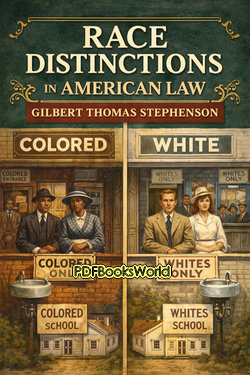
Race Distinctions in American Law
by Gilbert Thomas Stephenson
A Historical Study of Race and Legal Inequality in the United States
Race Distinctions in American Law by Gilbert Thomas Stephenson is a legal and historical study examining how racial distinctions were created, enforced, and maintained within American law. Written during the early twentieth century, the book analyzes legislation, court decisions, and legal systems that treated racial groups differently under the law.
The work reflects a period when racial segregation, discriminatory legislation, and unequal civil rights remained deeply embedded in American society. Stephenson approaches the subject through legal analysis, documenting how race affected citizenship, voting, marriage, education, labor, and public life.
The book remains historically significant because it preserves evidence of legal structures connected to racial inequality in the United States.
Examining Legal Systems and Racial Classification
The study explores laws distinguishing between racial groups in various states and regions of the country. Stephenson discusses legal definitions of race and how governments used these distinctions to regulate social and political rights.
The book examines subjects such as segregation, interracial marriage laws, citizenship restrictions, voting rights, and educational inequality. Court decisions and legal precedents receive detailed attention as examples of how racial distinctions became institutionalized.
The work demonstrates how law shaped everyday life and reinforced broader systems of social hierarchy and exclusion.
The Analytical Style of Gilbert Thomas Stephenson
Gilbert Thomas Stephenson writes in a formal and scholarly style focused strongly on legal evidence, statutes, and judicial interpretation. The work emphasizes documentation and analysis rather than emotional or literary presentation.
The language reflects the legal scholarship of the early twentieth century, where social issues were frequently examined through constitutional interpretation and legislative history.
The book serves both as a historical document and as a study of how law interacts with social and political structures.
Main Themes Explored in the Book
- Race and legal classification
- Segregation and civil inequality
- Citizenship, voting, and public rights
- The relationship between law and social systems
Why the Book Still Holds Historical Importance
Race Distinctions in American Law remains historically important because it documents legal systems that shaped racial inequality in the United States during a critical historical period. Readers interested in legal history and civil rights studies often examine the work to understand how discriminatory laws operated within American institutions.
The book also provides insight into the historical relationship between legal systems and broader social attitudes about race and citizenship.
Its documentation of institutional inequality continues to hold educational value.
The Lasting Importance of Legal History and Civil Rights Study
The study of historical legal systems helps explain how inequality can become embedded within political and social institutions. Understanding discriminatory laws remains important for examining later civil rights movements and constitutional reform.
Legal history also reveals how definitions of citizenship, equality, and justice have changed over time through political struggle and social activism.
The continuing study of civil rights and constitutional law helps preserve the significance of works like this.
Final Thoughts
Race Distinctions in American Law by Gilbert Thomas Stephenson is a historically significant legal study examining how racial distinctions were enforced through American legislation and judicial systems. Through detailed legal analysis and historical documentation, the book reveals the institutional foundations of racial inequality during the early twentieth century.
For readers interested in legal history, civil rights studies, political history, and American social development, this work remains both informative and historically important.
Similar Genres
About the Author
Gilbert Thomas Stephenson was an American lawyer, legal scholar, historian, and author whose writings examined the relationship between law, public policy, and race in the United States during the early twentieth century. Explore Gilbert Thomas Stephenson books to discover the author's life, literary career, and access notable works.