
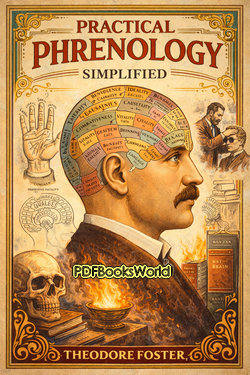
Practical Phrenology Simplified
by Theodore Foster
An Early Guide to the Popular Study of Phrenology
Practical Phrenology Simplified by Theodore Foster is an instructional work explaining the principles of phrenology, a nineteenth-century theory that claimed a person’s character and mental abilities could be understood by examining the shape of the skull. The book was written during a period when phrenology attracted widespread public interest in Europe and America.
Theodore Foster presents the subject in a practical and accessible way, aiming to help ordinary readers understand how phrenologists believed personality traits, intelligence, emotions, and behavior were connected to different areas of the brain and head.
Although phrenology is no longer accepted as scientific by modern standards, the book remains historically interesting as an example of earlier attempts to study human personality and psychology.
The Basic Ideas Behind Phrenology
The book explains the central belief of phrenology that different mental abilities and personality traits were located in separate regions of the brain. According to the theory, the size or development of these areas could supposedly influence the shape of the skull.
Phrenologists believed they could examine bumps, curves, and proportions of the head to identify characteristics such as intelligence, ambition, kindness, caution, creativity, or aggression.
Foster presents methods for observing and interpreting these features while explaining how phrenology was applied to education, behavior, relationships, and career guidance during the period.
The Clear and Instructional Style of Theodore Foster
Theodore Foster writes in a direct and organized style designed for readers with little scientific background. His explanations aim to simplify the subject and make phrenological ideas easy to understand.
The book reflects the confident tone often found in nineteenth-century popular science and self-improvement literature. Foster presents phrenology as a useful system for understanding human nature and personal development.
The writing combines practical instruction with strong belief in observation and classification.
Main Topics Discussed in the Book
- The principles and methods of phrenology
- Personality analysis through skull examination
- Mental abilities and emotional traits
- Self-improvement and human behavior
Why the Book Still Holds Historical Interest
Practical Phrenology Simplified remains valuable today mainly as a historical document reflecting nineteenth-century ideas about science, psychology, and human behavior. Readers interested in the history of science and social thought often study works like this to understand how people once attempted to explain personality and intelligence.
The book also demonstrates how strongly people of the period were interested in self-knowledge, personal improvement, and scientific classification.
Modern readers generally approach the work critically because phrenology has been rejected by modern neuroscience and psychology.
The Historical Influence of Phrenology
Although now considered pseudoscience, phrenology once influenced education, medicine, criminology, and public culture during the nineteenth century. Lectures, books, and public demonstrations made the subject highly popular for many decades.
The movement reflected a broader desire to explain human behavior scientifically, even if many of its methods and conclusions were incorrect.
Studying books like this helps modern readers understand the development of psychology and the changing relationship between science and society.
Final Thoughts
Practical Phrenology Simplified by Theodore Foster is an accessible guide to a once-popular theory about personality and the human mind. Through simple explanation and practical instruction, the book presents the ideas and methods of phrenology as they were understood during the nineteenth century.
For readers interested in the history of science, psychology, and social ideas, this work remains historically fascinating despite the later rejection of phrenology as scientific fact.
Similar Genres
About the Author
Theodore Foster was an American writer and lecturer who became known for presenting popular educational subjects in a clear and practical manner. His works reflected the nineteenth-century interest in understanding human behavior, personality, and self-improvement through scientific and philosophical ideas that were widely discussed during the period. Explore Theodore Foster books to discover the author's life, literary career, and access notable works.