
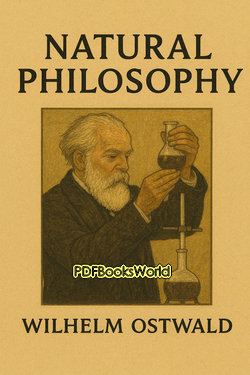
Natural Philosophy
by Wilhelm Ostwald
A Scientific Exploration of Nature and Human Understanding
Natural Philosophy by Wilhelm Ostwald is a thoughtful examination of the principles that govern the natural world and the methods by which humanity seeks to understand them. Ostwald, a Nobel Prize-winning chemist and influential scientific thinker, presents a broad discussion of science, knowledge, and the relationship between observation and theory. The book reflects a period when scientists were increasingly concerned not only with discovering facts but also with understanding the foundations of scientific inquiry itself.
By combining scientific explanation with philosophical reflection, Ostwald invites readers to consider how knowledge is acquired and how scientific ideas shape our view of reality.
The Meaning of Natural Philosophy
Before the term "science" became widely used in its modern sense, the study of nature was often referred to as natural philosophy. This discipline sought to explain the workings of the universe through observation, reasoning, and experimentation. Ostwald revisits this tradition, exploring the fundamental questions that lie behind scientific investigation.
He examines how natural laws are discovered and how human understanding evolves as new evidence and ideas emerge.
Major Subjects Discussed
- Scientific Method: The processes through which knowledge is tested and refined.
- Natural Laws: Principles that describe patterns and regularities in nature.
- Energy and Matter: Concepts central to modern scientific thought.
- Knowledge and Observation: The relationship between experience and understanding.
Science as a Way of Thinking
One of the book's central ideas is that science is more than a collection of facts. Ostwald emphasizes the importance of critical thinking, careful observation, and logical reasoning. He argues that scientific progress depends upon questioning assumptions and continually refining explanations in light of new evidence.
This perspective encourages readers to view science as an ongoing process of discovery rather than a fixed body of information.
Themes
- Curiosity: The desire to understand the world and its processes.
- Reason: Using logic and evidence to explore natural phenomena.
- Knowledge: The development and refinement of human understanding.
- Scientific Inquiry: The systematic investigation of nature.
- Progress: The advancement of learning through discovery and innovation.
A Bridge Between Science and Philosophy
Natural Philosophy demonstrates Ostwald's belief that scientific and philosophical questions are closely connected. By discussing both practical discoveries and broader intellectual issues, he provides readers with a deeper appreciation of the foundations of scientific thought.
The work reflects an era when leading scientists frequently engaged with philosophical questions about reality, knowledge, and the nature of existence.
An Enduring Reflection on Scientific Thought
Natural Philosophy remains an engaging read for those interested in the history of science, philosophy, and intellectual development. Through clear discussion and thoughtful analysis, Wilhelm Ostwald explores how humanity seeks to understand the universe and its underlying principles. The book stands as a valuable reminder that scientific inquiry is not only about discovering facts but also about asking meaningful questions and expanding the boundaries of human knowledge.
Similar Genres
About the Author
Wilhelm Ostwald was a German chemist, philosopher, educator, and Nobel Prize winner whose pioneering work helped establish modern physical chemistry as a scientific discipline. Awarded the Nobel Prize in Chemistry in 1909, he made significant contributions to chemical kinetics, catalysis, and the study of energy transformations. Explore Wilhelm Ostwald books to discover the author's life, literary career, and access notable works.