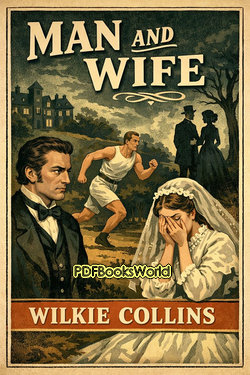
Man and Wife
by Wilkie Collins
Marriage, Manipulation, and Social Injustice in a Bold Victorian Drama
Man and Wife by Wilkie Collins is a powerful social and psychological novel examining marriage laws, women’s rights, emotional exploitation, ambition, and moral responsibility within Victorian society. Combining legal controversy with suspense, romance, and domestic conflict, the story critiques systems that allow personal relationships to become entangled with selfishness, social pressure, and institutional injustice.
Collins creates an emotionally charged narrative where affection, law, and power repeatedly collide.
A Marriage Becomes a Legal and Emotional Trap
The novel follows a network of interconnected families and relationships shaped by inheritance concerns, social ambition, romantic attachment, and legal uncertainty.
At the center stands Anne Silvester, a vulnerable yet emotionally sincere young woman whose future becomes endangered by manipulative individuals and confusing marriage laws that fail to protect her rights and security.
As romantic promises, social expectations, and legal technicalities intersect, questions arise concerning whether emotional commitment truly matches legal obligation.
Collins carefully exposes how selfishness and ambition can exploit both love and law for personal advantage.
The emotional tension deepens through jealousy, betrayal, illness, and growing fear surrounding marriage and social reputation.
The Figures Within the Domestic Conflict
- Anne Silvester: A sensitive and emotionally vulnerable woman struggling against manipulation and legal insecurity.
- Geoffrey Delamayn: An ambitious and morally weak man driven by vanity, selfishness, and social ambition.
- Blanche Lundie: A strong and intelligent woman confronting emotional conflict and difficult social realities.
- The Families and Legal Authorities: Figures representing Victorian expectations surrounding marriage, gender, and social status.
The emotional uncertainty surrounding loyalty and legal obligation drives the novel’s dramatic intensity.
Marriage Laws Versus Human Compassion
One of the novel’s strongest ideas is that legal systems governing marriage often fail to reflect emotional truth or moral fairness. Collins sharply criticizes laws that place women in vulnerable positions while allowing manipulation and irresponsibility to flourish.
The story repeatedly questions whether social institutions genuinely protect emotional wellbeing and justice.
Characters struggle between legal appearances and authentic emotional commitment.
This combination of social criticism and psychological drama gives the narrative remarkable depth and modern relevance.
Major Themes Running Through the Novel
- Marriage and Legal Injustice: Victorian marriage laws create vulnerability, confusion, and emotional suffering.
- Manipulation and Social Ambition: Characters exploit relationships and legal systems for personal advantage.
- Female Vulnerability and Strength: Women confront restrictive social structures while preserving emotional resilience.
- Love, Loyalty, and Moral Responsibility: Emotional sincerity conflicts with selfishness and social expectation.
Collins’s Fierce Blend of Fiction and Social Critique
Man and Wife demonstrates Wilkie Collins’s ability to combine suspenseful storytelling with direct engagement in contemporary social issues. While the novel contains romance, mystery, and emotional drama, it also functions as a passionate criticism of unfair legal and social systems.
Collins balances intimate character relationships with broader reflections on gender, power, and institutional injustice.
The pacing steadily intensifies as emotional and legal conflicts become increasingly dangerous.
Why the Novel Still Feels Important
Modern readers continue finding Man and Wife compelling because its themes remain strikingly relevant. Questions involving consent, emotional exploitation, gender inequality, and the relationship between law and personal autonomy continue shaping modern society.
The novel also stands among Collins’s most socially courageous and emotionally complex works.
For readers interested in Victorian social fiction, legal drama, psychologically rich relationships, and emotionally powerful critiques of marriage and society, this work remains thoughtful, passionate, and deeply engaging.
Similar Genres
About the Author

Wilkie Collins earned a lasting reputation as one of the pioneers of modern mystery and sensation fiction. Born in London in 1824, he developed a storytelling style that combined suspense, memorable characters, and carefully constructed plots, keeping readers engaged from beginning to end. Explore Wilkie Collins books to discover the author's life, literary career, and access notable works, including The Moonstone, The Woman in White, After Dark, Basil , and more.