
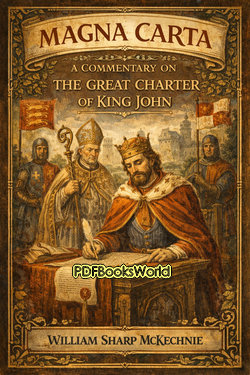
Magna Carta - A Commentary on the Great Charter of King John
by William Sharp McKechnie
A Scholarly Examination of One of History’s Most Important Constitutional Documents
Magna Carta - A Commentary on the Great Charter of King John by William Sharp McKechnie is a detailed legal and historical study of the Magna Carta, the famous charter granted by King John of England in 1215. Widely regarded as one of the foundational documents in the development of constitutional government and legal rights, the Magna Carta has influenced political thought and legal systems for centuries.
McKechnie’s commentary carefully analyzes the clauses of the charter within their historical, political, and legal context. The work explores the struggles between monarchy and nobility, the evolution of English law, and the long-term constitutional significance of the document.
The volume blends legal scholarship with medieval history and constitutional analysis.
The Historical Background of Magna Carta
Magna Carta: The charter issued in 1215 after conflict between King John and rebellious English barons seeking to limit royal authority and protect traditional feudal rights.
The book examines the political tensions, taxation disputes, military failures, and legal grievances that led to the creation of the charter at Runnymede. McKechnie also explores how individual clauses reflected the concerns of medieval society and governance.
King John: The English monarch whose troubled reign and disputes with the nobility resulted in one of the most famous constitutional agreements in history.
The narrative demonstrates how a medieval political compromise gradually became a symbol of liberty and lawful government.
The Scholarly Style of William Sharp McKechnie
William Sharp McKechnie writes in a precise and analytical style emphasizing legal interpretation, historical documentation, and constitutional development. His scholarship reflects deep engagement with medieval law and political history.
The prose combines detailed textual analysis with broader historical explanation designed for serious students and readers of legal history.
McKechnie’s methodical approach gives the work lasting academic importance.
Main Themes and Constitutional Reflection
The book explores themes of law, liberty, political authority, constitutional limitation, justice, feudal rights, governance, legal tradition, and the balance between ruler and subject.
Through clause-by-clause analysis and historical interpretation, the work examines how legal principles evolve and gain broader significance over time.
Why the Book Still Holds Importance
Magna Carta - A Commentary on the Great Charter of King John remains valuable because Magna Carta continues to occupy a central place in the history of constitutional law and political liberty. Scholars of law, history, and political theory frequently consult McKechnie’s work for its detailed historical and legal insight.
The book also helps modern readers understand the medieval origins of concepts later associated with due process, legal restraint, and representative government.
Its combination of historical depth and legal analysis continues to make it highly respected.
The Lasting Importance of Magna Carta
Although originally intended to resolve specific medieval disputes, Magna Carta gradually became a powerful symbol of legal rights and limitations on government authority. It influenced later constitutional developments in England, the United States, and other legal traditions.
Its ideas about lawful governance and protection against arbitrary power became central to modern constitutional thought.
The continuing study of constitutional history and political liberty helps preserve appreciation for works like this.
Final Thoughts
Magna Carta - A Commentary on the Great Charter of King John by William Sharp McKechnie is a rigorous and historically rich examination of one of the most influential legal documents in world history. Through detailed scholarship and constitutional analysis, the book illuminates the political struggles, legal principles, and enduring legacy of Magna Carta.
For readers interested in legal history, constitutional government, medieval England, and political thought, this work remains both intellectually important and historically fascinating.
Similar Genres
About the Author
William Sharp McKechnie was a Scottish legal scholar, historian, and professor whose research on constitutional law and medieval history earned lasting recognition among students of legal history. Explore William Sharp McKechnie books to discover the author's life, literary career, and access notable works.