Kenneth Honea
Kenneth Honea was an American archaeologist and researcher whose work focused on the earliest human inhabitants of North America and the material evidence they left behind. His writings helped explain archaeological discoveries in a clear and accessible manner, allowing both specialists and general readers to better understand prehistoric cultures. By carefully studying stone tools, excavation sites, and ancient environments, Honea contributed to the growing body of knowledge about early human migration and technological development in the American Southwest. His work Early Man Projectile Points in the Southwest reflects his dedication to documenting and interpreting one of the most important categories of prehistoric artifacts.
A Researcher of Early American Prehistory
Kenneth Honea devoted his attention to the archaeological record of the American Southwest, a region rich in evidence of early human occupation. During the twentieth century, advances in excavation methods and dating techniques enabled archaeologists to reconstruct increasingly detailed pictures of prehistoric life. Honea participated in this expanding field by examining the stone tools used by ancient hunters and gathering information about the people who produced them. His research emphasized careful observation, accurate documentation, and the importance of preserving archaeological sites for future study.
Rather than viewing artifacts as isolated objects, Honea interpreted them as clues to the lives, movements, and technological skills of early communities. His work demonstrated how even small discoveries could reveal valuable information about hunting practices, environmental adaptation, and cultural development over thousands of years.
Understanding Projectile Points
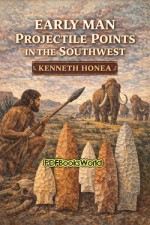
In Early Man Projectile Points in the Southwest, Honea examines the distinctive stone points used by prehistoric peoples for hunting and survival. He discusses their shapes, methods of manufacture, distribution, and archaeological significance, explaining how these artifacts help researchers identify cultural traditions and establish chronological sequences. The book highlights the importance of projectile points as evidence for understanding early human migration, technological innovation, and adaptation to changing environments. It remains a useful historical introduction to archaeological classification and the study of prehistoric tools.
A Clear and Scientific Approach
Honea wrote in a straightforward style that balanced scientific accuracy with readability. His explanations are carefully organized, allowing readers to follow archaeological reasoning without requiring extensive prior knowledge of the subject. Illustrations, descriptions, and comparisons of artifact types help demonstrate how archaeologists interpret physical evidence to reconstruct the distant past. This practical approach makes the work valuable to students, history enthusiasts, and anyone interested in the archaeology of North America.
An Enduring Legacy
Kenneth Honea is remembered for his contribution to the study of prehistoric archaeology and the material culture of the earliest peoples of the American Southwest. His careful documentation of projectile points has helped preserve important archaeological knowledge while encouraging greater appreciation for the scientific methods used to investigate ancient history. Early Man Projectile Points in the Southwest continues to serve as a valuable historical resource for readers interested in archaeology, early technology, and the first inhabitants of North America. Visitors to PDF Books World can explore Honea's public domain writings to discover informative works that illuminate humanity's distant past through careful research and archaeological discovery.