
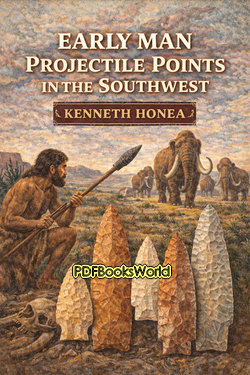
Early Man Projectile Points in the Southwest
by Kenneth Honea
A Scientific Study of Ancient Tools and Early Human Life in the American Southwest
Early Man Projectile Points in the Southwest by Kenneth Honea is an archaeological and anthropological study examining prehistoric projectile points used by early human populations in the southwestern regions of North America. Through analysis of stone tools and weapon technology, the work contributes to understanding ancient hunting practices, migration patterns, and cultural development.
The book reflects the growing scientific interest in prehistoric archaeology and the reconstruction of early human history through material evidence. Projectile points, often associated with spears and hunting weapons, serve as important clues helping researchers identify technological advancement, cultural traditions, and patterns of settlement.
The work combines archaeological research with historical interpretation and scientific analysis.
Studying Ancient Projectile Points
The book examines the shapes, materials, construction methods, and classifications of projectile points discovered in the American Southwest. Differences in design help archaeologists identify cultural groups, estimate time periods, and understand changing hunting practices.
Stone points provide evidence about how early humans adapted to environmental conditions and pursued large game animals in prehistoric landscapes. The study likely discusses excavation sites, dating methods, and comparisons between regional artifact styles.
The careful analysis of tools becomes a way of reconstructing ancient human activity and survival strategies.
The Scientific Style of Kenneth Honea
Kenneth Honea writes in a clear and research-oriented style emphasizing evidence, classification, and archaeological interpretation. The work focuses on factual observation while making prehistoric material understandable for readers interested in archaeology and anthropology.
The language reflects academic archaeological writing concerned with precision, documentation, and scientific method.
Honea’s systematic approach gives the study scholarly value and historical importance.
Main Themes and Archaeological Ideas
The book explores themes of prehistoric technology, survival, adaptation, migration, hunting culture, and scientific investigation of ancient societies. It also reflects the importance of material artifacts in reconstructing human history before written records.
Through analysis of projectile points and archaeological evidence, the work examines how early humans interacted with their environment and developed practical technologies.
Why the Book Still Holds Importance
Early Man Projectile Points in the Southwest remains valuable because projectile point studies continue to play an important role in North American archaeology and prehistoric research. Readers interested in ancient cultures and archaeological method often appreciate detailed artifact studies like this.
The work also contributes to understanding the early human presence in the American Southwest and the technological development of prehistoric societies.
Its scientific focus and archaeological detail continue to make it useful for historical study.
The Lasting Importance of Archaeological Artifact Studies
Artifact analysis became central to archaeology because tools, weapons, pottery, and other objects often provide the most direct evidence of prehistoric life. Projectile points are especially important because their forms can help identify cultural traditions and historical time periods.
Archaeological studies of the American Southwest revealed rich evidence of ancient human adaptation within diverse desert and mountain environments.
The continuing fascination with prehistoric cultures and human origins helps preserve appreciation for works like this.
Final Thoughts
Early Man Projectile Points in the Southwest by Kenneth Honea is an informative archaeological study exploring prehistoric tools, hunting practices, and early human life in the American Southwest. Through scientific analysis and careful observation, the work reveals how ancient artifacts contribute to understanding humanity’s distant past.
For readers interested in archaeology, anthropology, prehistoric technology, and ancient North American cultures, this work remains both educational and historically important.
Similar Genres
About the Author
Kenneth Honea was an American archaeologist and researcher whose work focused on the earliest human inhabitants of North America and the material evidence they left behind. His writings helped explain archaeological discoveries in a clear and accessible manner, allowing both specialists and general readers to better understand prehistoric cultures. Explore Kenneth Honea books to discover the author's life, literary career, and access notable works.