Joseph Black
Joseph Black was a Scottish physician, chemist, and educator whose pioneering experiments laid the foundation for modern chemistry and thermodynamics. He is best remembered for discovering carbon dioxide, which he referred to as "fixed air," and for developing the concepts of latent heat and specific heat. These discoveries transformed scientific understanding of gases and heat, influencing generations of chemists, physicists, and engineers. As a professor at the Universities of Glasgow and Edinburgh, Black became renowned for his clear lectures and careful experimental methods, inspiring many of the leading scientists of the eighteenth century.
Discoveries That Changed Chemistry
Black believed that scientific knowledge should be built upon precise observation and carefully designed experiments. His investigations into chemical reactions revealed that gases could be treated as distinct substances rather than invisible by-products, a revolutionary idea for his time. His discovery of carbon dioxide opened new directions in chemical research and helped establish chemistry as an experimental science based on measurable evidence.
His studies of heat were equally influential. By introducing the concepts of latent heat and specific heat, Black provided scientists with new ways to understand changes in temperature and the behavior of matter. These ideas later played a crucial role in the development of thermodynamics and the improvement of steam engines.
Inspiring Generations Through Teaching
Joseph Black was widely admired as a teacher whose lectures combined scientific accuracy with remarkable clarity. Students traveled from across Britain and Europe to attend his classes, where he demonstrated experiments that made complex chemical principles easy to understand. His emphasis on careful measurement and logical reasoning shaped the work of many future scientists and strengthened the reputation of chemistry as a rigorous scientific discipline.
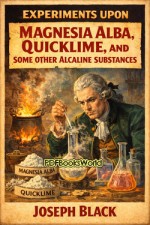
Among his earliest and most influential publications is Experiments upon Magnesia Alba, Quicklime, and Some Other Alcaline Substances, which describes the research that led to the discovery of carbon dioxide. The work marks one of the most significant milestones in the history of experimental chemistry.
Major Works
- Experiments upon Magnesia Alba, Quicklime, and Some Other Alcaline Substances – Describes the experiments that led to the discovery of carbon dioxide and advanced chemical science.
- Lectures on the Elements of Chemistry – A collection of influential lectures explaining the principles and methods of chemistry.
- Papers on Latent Heat and Specific Heat – Introduces the concepts that transformed the scientific understanding of heat and energy.
A Lasting Foundation for Modern Science
Joseph Black's discoveries reshaped the study of chemistry and physics by demonstrating the importance of careful experimentation and quantitative observation. His work influenced many of the greatest scientists of the eighteenth and nineteenth centuries, while his educational contributions helped establish chemistry as a respected academic discipline. His legacy continues to be recognized as one of the cornerstones of modern scientific thought.
Readers visiting PDF Books World can explore the works of Joseph Black and discover classic scientific writings that illustrate the beginnings of modern chemistry and the enduring value of experimental research.