
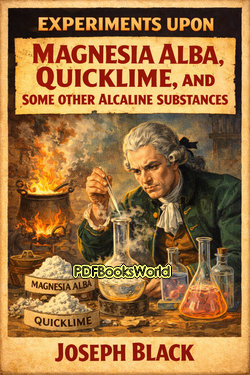
Experiments upon magnesia alba, Quicklime, and some other Alcaline Substances
by Joseph Black
Chemical Experimentation, Fixed Air, and the Foundations of Modern Chemistry
Experiments upon Magnesia Alba, Quicklime, and Some Other Alcaline Substances by Joseph Black is one of the landmark scientific works in the history of chemistry. First published in the eighteenth century, the study presents Black’s groundbreaking experiments concerning chemical reactions, gases, heat, and alkaline substances, helping establish chemistry as a precise experimental science grounded in measurement and observation.
Black’s investigations introduced important ideas concerning carbon dioxide, then called “fixed air,” and demonstrated how careful experimentation could reveal invisible chemical processes occurring within matter.
The Discovery of Fixed Air and Chemical Transformation
The book focuses upon Black’s experiments involving substances such as magnesia alba, limestone, quicklime, and alkaline compounds. Through careful heating and measurement, he discovered that certain materials released an invisible gas during chemical reactions.
Black identified this gas as a distinct substance different from ordinary air, marking one of the earliest scientific recognitions of carbon dioxide.
He also demonstrated that chemical substances could gain or lose weight through interaction with gases, helping challenge older assumptions about matter and transformation.
Rather than relying upon speculation or traditional alchemical theory, the work emphasizes quantitative experimentation, precise measurement, and repeatable observation.
The volume reflects a crucial stage in the Scientific Revolution when chemistry was beginning to emerge as a modern laboratory science.
Its tone combines experimental rigor with analytical clarity and scientific curiosity.
Scientific Concepts Explored Throughout the Work
- Fixed Air and Carbon Dioxide: Black identifies a distinct gas released during chemical reactions involving alkaline substances.
- Chemical Reactions and Transformation: The experiments demonstrate how matter changes through heating and combination with gases.
- Quantitative Scientific Method: Careful measurement and observation become essential tools for chemical investigation.
- The Foundations of Modern Chemistry: The work helped move chemistry away from speculative alchemy toward experimental science.
The book represents one of the major turning points in the development of modern chemical theory.
The Invisible Processes Governing Matter
One of the work’s strongest ideas is that important chemical changes often involve invisible substances and processes not immediately apparent to ordinary observation.
Black repeatedly demonstrates how careful experimentation can reveal hidden interactions between solids, gases, heat, and air.
The book also shows how precise scientific measurement transformed chemistry into a more exact and reliable discipline.
This emphasis on experiment and evidence strongly influenced later chemists including Antoine Lavoisier and helped prepare the way for modern chemical science.
Joseph Black’s Experimental Scientific Style
Experiments upon Magnesia Alba, Quicklime, and Some Other Alcaline Substances demonstrates Joseph Black’s remarkable ability to combine careful laboratory observation with logical scientific reasoning.
The writing remains methodical, disciplined, and strongly focused upon establishing conclusions through experimental proof.
Black consistently presents chemistry as a science that must be built upon direct observation rather than philosophical speculation alone.
Why the Work Still Holds Importance Today
Modern readers continue finding Experiments upon Magnesia Alba, Quicklime, and Some Other Alcaline Substances historically and scientifically important because it introduced foundational concepts concerning gases, chemical reactions, and quantitative experimentation.
The work also provides insight into the early development of modern chemistry before atomic theory and modern laboratory technology transformed the field.
Black’s discovery of fixed air became one of the major scientific advances leading toward modern understanding of gases, respiration, combustion, and atmospheric chemistry.
For readers interested in chemistry, scientific history, laboratory science, gas theory, experimental method, and the Scientific Revolution, this work remains groundbreaking, intellectually significant, and historically transformative.
Similar Genres
About the Author
Joseph Black was a Scottish physician, chemist, and educator whose pioneering experiments laid the foundation for modern chemistry and thermodynamics. He is best remembered for discovering carbon dioxide, which he referred to as "fixed air," and for developing the concepts of latent heat and specific heat. Explore Joseph Black books to discover the author's life, literary career, and access notable works.