
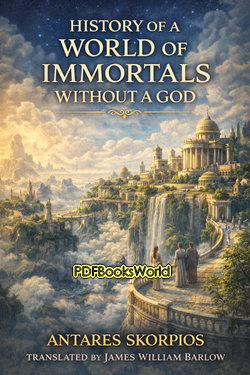
History of a World of Immortals without a God
by James William Barlow
A Visionary Exploration of Society, Morality, and Human Destiny
History of a World of Immortals without a God by James William Barlow is a thought-provoking work of speculative fiction that imagines a society populated by immortal beings who exist without belief in a divine creator. First published in the late nineteenth century, the novel combines philosophy, social criticism, science fiction, and utopian speculation to explore profound questions about morality, purpose, government, and the future of civilization.
Rather than focusing on adventure alone, Barlow uses his fictional world as a framework for examining how intelligent beings might organize society if freed from death and traditional religious structures. The result is an ambitious and intellectually engaging narrative that challenges readers to reconsider assumptions about human nature and social order.
An Unusual Premise
The novel's central idea is both simple and radical: what would happen if a civilization consisted of immortal individuals who possessed no concept of God? By removing two forces that have historically shaped human societies, mortality and religion, Barlow creates an opportunity to explore alternative foundations for ethics, law, and culture.
The fictional world becomes a laboratory for philosophical inquiry, allowing readers to examine familiar issues from a fresh perspective.
Characters
- The Narrator: A visitor and observer who learns about the immortal society and serves as the reader's guide to its customs and institutions.
- Hin Su: A distinguished citizen whose conversations help explain the beliefs, history, and organization of the immortal world.
- Various Immortal Citizens: Representatives of different viewpoints who participate in discussions about morality, governance, education, and social progress.
The novel places greater emphasis on ideas and social systems than on individual character drama, making its philosophical discussions a central feature of the narrative.
Life in an Immortal Society
Immortality transforms nearly every aspect of existence. Questions that concern ordinary human beings, such as aging, inheritance, and the limited span of life, take on entirely different meanings. The inhabitants of Barlow's world must create institutions and values suited to an existence without natural death.
This premise allows the author to explore how long-term thinking might influence culture, education, and political decision-making.
Major Themes Found Throughout the Novel
- Immortality: The social and personal consequences of endless life.
- Morality: Ethical systems independent of religious belief.
- Social Organization: Alternative approaches to government and law.
- Human Progress: The relationship between knowledge, reason, and civilization.
These themes place the novel among the most ambitious speculative works of its era.
Religion and Ethics
A major focus of the book is the question of whether morality requires religious foundations. Barlow presents a society that seeks to base ethical behavior on reason, experience, and collective well-being rather than divine authority. Through debates and observations, the novel examines the strengths and weaknesses of this approach.
The discussion remains relevant because it addresses questions that continue to interest philosophers and social thinkers.
A Utopian and Philosophical Tradition
The novel belongs to a long tradition of works that imagine alternative societies in order to evaluate existing ones. Like many utopian and speculative texts, it uses a fictional setting to encourage reflection on contemporary political, social, and religious issues.
Readers are invited not merely to observe this world but to compare it with their own.
Why Readers Continue to Find the Book Interesting
- Original Concept: A civilization of immortals without religion.
- Philosophical Depth: Exploration of ethics, society, and human purpose.
- Historical Significance: An early work of speculative and utopian fiction.
- Intellectual Challenge: Questions that remain relevant today.
Why History of a World of Immortals without a God Remains Worth Reading
History of a World of Immortals without a God is a remarkable blend of fiction and philosophy that uses an imaginative premise to explore some of humanity's most enduring questions. Through its depiction of an immortal society governed by reason rather than religious belief, James William Barlow invites readers to think deeply about morality, progress, and the foundations of civilization. The novel remains an intriguing and influential contribution to the history of speculative thought and utopian literature.
Similar Genres
About the Author
James William Barlow was an Irish physician, scientist, and novelist whose writings combined scientific curiosity with philosophical imagination. Best remembered for his speculative fiction, Barlow explored profound questions about human existence, morality, society, and the future through imaginative narratives rather than conventional storytelling. Explore James William Barlow books to discover the author's life, literary career, and access notable works.