
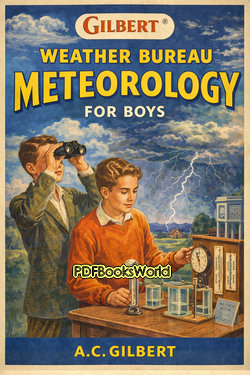
Gilbert Weather Bureau (Meteorology) for Boys
by A. C. Gilbert
Introducing Young Readers to the Science of Weather
Gilbert Weather Bureau (Meteorology) for Boys by A. C. Gilbert is an educational guide designed to spark interest in the fascinating science of weather. Published during an era when scientific hobbies and home experiments were becoming increasingly popular, the book encourages young readers to observe, record, and understand the atmospheric conditions that influence daily life. Combining practical instruction with scientific curiosity, it introduces the basic principles of meteorology in an accessible and engaging manner.
A. C. Gilbert, famous for creating educational toys and science sets, believed that learning should be hands-on and enjoyable. This philosophy is evident throughout the book, which encourages readers to become active observers rather than passive learners.
What Is Meteorology?
Meteorology is the scientific study of the atmosphere and weather. It seeks to explain why clouds form, how storms develop, what causes wind, and why temperatures change from day to day. For young readers, these questions provide an exciting introduction to scientific investigation.
The book presents weather not as a series of random events but as a system governed by observable patterns and natural laws. By understanding these patterns, readers gain a greater appreciation for the world around them.
Learning Through Observation
One of the central ideas of the book is that careful observation is the foundation of science. Readers are encouraged to monitor weather conditions, keep records, and compare results over time. Such activities help develop analytical thinking while making the learning process enjoyable.
Through simple observations of clouds, wind direction, rainfall, and temperature, young enthusiasts can begin to recognize patterns that professional meteorologists study on a larger scale.
Important Weather Topics Covered
- Cloud Formation: Understanding different cloud types and what they indicate.
- Temperature: Measuring changes in atmospheric conditions.
- Wind: Observing direction and strength.
- Rain and Storms: Learning how weather systems develop.
These topics provide a foundation for further exploration of atmospheric science.
The Educational Value of Weather Study
Weather is an ideal subject for young scientists because it can be observed every day. Unlike some scientific fields that require specialized laboratories, meteorology begins with simple attention to the environment. The sky, the wind, and changing temperatures become natural classrooms.
The book emphasizes that scientific knowledge grows through curiosity and careful record-keeping. Readers learn not only facts about weather but also the methods scientists use to investigate natural phenomena.
A. C. Gilbert's Hands-On Philosophy
A. C. Gilbert was a pioneer in educational learning through practical experience. He believed that children learned best when they actively participated in experiments and observations. His educational products and publications were designed to encourage exploration, creativity, and problem-solving.
In Gilbert Weather Bureau (Meteorology) for Boys, this philosophy appears in the emphasis on building observational skills and engaging directly with scientific concepts. The book transforms weather study into an adventure of discovery.
Major Themes Found Throughout the Book
- Scientific Curiosity: Encouraging questions about the natural world.
- Observation: Learning through direct experience and record-keeping.
- Education: Making science accessible and enjoyable.
- Discovery: Exploring the atmosphere and its many phenomena.
These themes help make the book both informative and inspiring for young readers.
Why Gilbert Weather Bureau (Meteorology) for Boys Remains Interesting
Gilbert Weather Bureau (Meteorology) for Boys remains a fascinating example of early science education. Through its practical approach to meteorology, A. C. Gilbert encourages readers to observe the world carefully, ask questions, and seek explanations based on evidence. The book not only introduces the science of weather but also promotes habits of curiosity and investigation that are valuable in every area of learning. As a result, it continues to offer insight into both meteorology and the history of science education.
Similar Genres
About the Author
A. C. Gilbert, better known as Alfred Carlton Gilbert, was an American inventor, entrepreneur, athlete, and educator whose innovative educational toys inspired generations of young people to explore science, engineering, and practical skills. Best known as the creator of the famous Erector Set, Gilbert believed that learning should be interactive, imaginative, and enjoyable. Explore A. C. Gilbert books to discover the author's life, literary career, and access notable works.