
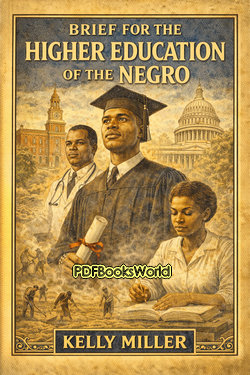
Brief for the higher education of the negro
by Kelly Miller
A Powerful Argument for Educational Opportunity and Intellectual Advancement
Brief for the Higher Education of the Negro by Kelly Miller is an important social and educational work defending the value of higher education for African Americans during the late nineteenth and early twentieth centuries. Written during a period of racial discrimination and limited educational access, the book argues that intellectual development and academic opportunity were essential for social progress, equality, and national advancement.
Kelly Miller, a prominent African American mathematician, sociologist, and educator, presents education as both a personal right and a necessary foundation for leadership, citizenship, and cultural growth. The work reflects major debates of the period concerning race, education, labor, and the future of African American communities after Reconstruction.
The book stands as a significant contribution to the history of African American thought and educational reform.
Defending the Importance of Higher Education
Miller argues that African Americans should have access not only to industrial or vocational training, but also to advanced academic education in subjects such as literature, science, philosophy, law, and public leadership.
He challenges the belief that Black education should remain limited to manual labor training alone. According to Miller, higher education helps develop intellectual leadership, social responsibility, and cultural achievement within a community.
The work also emphasizes that educational opportunity strengthens democracy and benefits society as a whole rather than only individual students.
The Intellectual Style of Kelly Miller
Kelly Miller writes in a logical, persuasive, and thoughtful style combining social analysis with moral argument. His language reflects both scholarly training and deep concern for justice and educational equality.
The writing remains clear and forceful while addressing complicated social and political questions. Miller often supports his arguments through reasoned discussion rather than emotional rhetoric alone.
His balanced but determined approach helped make him one of the important intellectual voices of his era.
Main Themes Explored in the Book
- Higher education and intellectual opportunity
- Racial equality and social progress
- Leadership, citizenship, and community development
- The role of education in democracy
Why the Book Still Holds Historical Importance
Brief for the Higher Education of the Negro remains historically important because it documents debates about race, education, and opportunity during a critical period in American history. Readers interested in African American history and educational reform often study the work as part of the broader struggle for equality and civil rights.
The book also reveals how African American intellectuals argued for full participation in academic and cultural life despite widespread discrimination and segregation.
Its defense of intellectual opportunity continues to feel meaningful today.
The Lasting Importance of Educational Equality
Access to education has long been connected to questions of freedom, citizenship, and social advancement. During the late nineteenth and early twentieth centuries, debates over African American education became central to discussions about democracy and racial justice in the United States.
Thinkers like Kelly Miller emphasized that higher education was necessary for developing leadership, professional achievement, and cultural contribution within marginalized communities.
The continuing importance of educational access and equality helps preserve the relevance of works like this.
Final Thoughts
Brief for the Higher Education of the Negro by Kelly Miller is a thoughtful and historically significant argument for educational opportunity, intellectual advancement, and social equality. Through reasoned discussion and moral conviction, Miller defends the importance of higher education as a foundation for leadership, dignity, and democratic progress.
For readers interested in African American history, educational reform, sociology, and intellectual history, this work remains both important and inspiring.
Similar Genres
About the Author
Kelly Miller was an American mathematician, sociologist, educator, and author whose influential writings helped shape discussions on education, civil rights, and racial equality during the late nineteenth and early twentieth centuries. Explore Kelly Miller books to discover the author's life, literary career, and access notable works.