
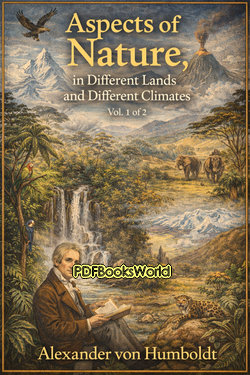
Aspects of Nature, in Different Lands and Different Climates Vol 1 of 2
by Alexander von Humboldt
A Classic Exploration of the Natural World Across Continents
Aspects of Nature, in Different Lands and Different Climates (Vol. I) by Alexander von Humboldt is one of the most celebrated works of scientific and travel literature of the nineteenth century. Drawing upon decades of observation and exploration, Humboldt presents vivid descriptions of landscapes, plants, animals, geological formations, and climatic conditions from various parts of the world. The book reflects his belief that nature should be studied as an interconnected whole rather than as isolated phenomena.
Combining scientific insight with literary elegance, Humboldt invites readers to experience the diversity and grandeur of the natural world. His observations helped shape modern environmental thinking and influenced generations of scientists, naturalists, and writers.
A Vision of Nature as a Unified System
One of Humboldt's most important contributions was his view that all elements of nature are connected. Climate, geography, vegetation, wildlife, and human activity interact in complex ways, forming a vast network of relationships. Throughout the volume, he demonstrates how understanding one aspect of nature often requires understanding many others.
This holistic perspective was innovative for its time and remains influential today.
Journeys Through Diverse Landscapes
The book takes readers through a variety of environments, including tropical forests, mountain ranges, river systems, and coastal regions. Humboldt's detailed descriptions capture both the scientific significance and the aesthetic beauty of these places.
His ability to combine careful observation with expressive prose allows readers to appreciate the richness of landscapes they may never personally visit.
Highlights of the Volume
- Global Perspective: Observations from multiple continents and climates.
- Scientific Exploration: Studies of geography, botany, and natural history.
- Environmental Insight: Recognition of the interconnectedness of nature.
- Travel Narrative: Accounts inspired by extensive exploration.
- Literary Style: Scientific ideas expressed through vivid descriptions.
Climate and Geography
Humboldt pays particular attention to the influence of climate on natural environments. He examines how temperature, altitude, rainfall, and other factors affect vegetation and animal life. By comparing different regions, he reveals patterns that help explain the distribution of species and ecosystems.
These observations contributed significantly to the development of biogeography and ecological science.
Major Themes
- Interconnection: The relationships linking all parts of nature.
- Exploration: Expanding knowledge through observation and travel.
- Diversity: The variety of life and environments on Earth.
- Scientific Curiosity: Seeking understanding through careful study.
- Natural Beauty: Appreciating the aesthetic qualities of the world.
Alexander von Humboldt's Legacy
Alexander von Humboldt is widely regarded as one of the founders of modern geography and environmental science. His travels throughout the Americas and other regions produced an extraordinary body of knowledge that influenced fields ranging from ecology to climatology. He inspired many later scientists, including Charles Darwin, through his commitment to observation and interdisciplinary study.
His writings helped transform the way people understood the natural world and humanity's place within it.
Why the Book Remains Important
Aspects of Nature, in Different Lands and Different Climates (Vol. I) remains a landmark work because it combines scientific investigation with a deep appreciation for nature's beauty and complexity. Humboldt's vision of a connected and dynamic natural world anticipated many ideas that are central to modern environmental science.
For readers interested in natural history, geography, exploration, and scientific thought, the volume offers a fascinating journey through diverse landscapes and ecosystems. Its blend of observation, insight, and literary craftsmanship ensures its enduring significance.
Similar Genres
About the Author
Alexander von Humboldt was a German naturalist, explorer, geographer, and scientist whose groundbreaking studies transformed the understanding of the natural world. Through extensive expeditions across South America, Central America, and parts of Asia and Europe, he carefully observed the relationships between climate, geography, plants, animals, and human societies. Explore Alexander von Humboldt books to discover the author's life, literary career, and access notable works.