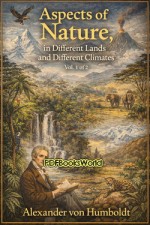
Alexander von Humboldt
Alexander von Humboldt was a German naturalist, explorer, geographer, and scientist whose groundbreaking studies transformed the understanding of the natural world. Through extensive expeditions across South America, Central America, and parts of Asia and Europe, he carefully observed the relationships between climate, geography, plants, animals, and human societies. His work emphasized that nature functions as an interconnected system, an idea that profoundly influenced modern ecology, geography, and environmental science. Aspects of Nature, in Different Lands and Different Climates beautifully reflects his ability to combine scientific observation with vivid literary description, inviting readers to appreciate the diversity and unity of Earth's landscapes.
A Pioneer of Scientific Exploration
Alexander von Humboldt devoted his life to exploring regions that were largely unfamiliar to European science. Equipped with scientific instruments and an insatiable curiosity, he measured mountains, mapped rivers, studied volcanic activity, and recorded thousands of plant and animal species. His expeditions produced an extraordinary collection of observations that greatly expanded knowledge of geography, meteorology, botany, geology, and zoology.
Unlike many explorers of his era, Humboldt believed that individual discoveries gained greater meaning when viewed as part of a larger natural system. His holistic approach encouraged scientists to examine how climate, elevation, vegetation, and wildlife influence one another, laying important foundations for environmental research.
Blending Science with Beautiful Writing
Humboldt possessed the rare ability to communicate scientific ideas through engaging and expressive prose. His books combine precise observations with vivid descriptions of mountains, forests, rivers, deserts, and tropical landscapes, allowing readers to experience the wonder of exploration alongside scientific discovery. He believed that understanding nature should inspire both intellectual curiosity and emotional appreciation.
His writing appealed to scientists as well as general readers because it balanced factual accuracy with literary elegance. This distinctive style helped popularize scientific exploration and encouraged broader public interest in the natural sciences.
Popular Works
- Aspects of Nature, in Different Lands and Different Climates – A celebrated collection of essays exploring the beauty and interconnectedness of Earth's diverse environments.
- Cosmos – A monumental work presenting a comprehensive view of the physical universe and the unity of nature.
- Personal Narrative of Travels to the Equinoctial Regions of America – A detailed account of his scientific expeditions through Central and South America.
- Political Essay on the Kingdom of New Spain – An influential study of the geography, economy, and society of colonial Mexico.
- Views of Nature – A collection of scientific reflections that combine natural history with literary observation.
His Influence on Modern Science
Alexander von Humboldt's ideas shaped numerous scientific disciplines, including ecology, biogeography, climatology, environmental science, and physical geography. His concept of nature as an interconnected network inspired generations of scientists, explorers, and conservationists. Many influential thinkers, including Charles Darwin, acknowledged Humboldt's profound impact on their own work and scientific outlook.
His research also demonstrated the value of combining careful measurement with broad observation. By comparing different regions and climates, he revealed patterns that helped explain the distribution of plants, animals, and ecosystems across the globe.
An Enduring Legacy
Alexander von Humboldt is widely regarded as one of history's greatest scientific explorers. His writings continue to inspire readers with their combination of intellectual depth, adventurous spirit, and appreciation for the natural world. Modern environmental science still reflects many of the principles he first articulated, particularly the understanding that Earth's systems are closely interconnected.
His legacy extends far beyond geography and natural history. By encouraging readers to see humanity as part of a larger ecological system, Humboldt helped shape modern attitudes toward conservation, scientific inquiry, and environmental responsibility. His works remain essential reading for anyone interested in the history of science and the beauty of nature.
Aspects of Nature, in Different Lands and Different Climates is a remarkable example of Alexander von Humboldt's ability to unite scientific knowledge with literary expression. PDF Books World carefully curates editions of his classic works, allowing modern readers to experience the observations and ideas of one of the world's most influential explorers and natural scientists.