
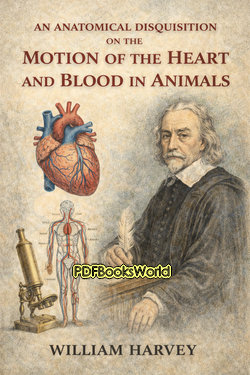
An Anatomical Disquisition on the Motion of the Heart & Blood in Animals
by William Harvey
A Revolutionary Work That Transformed Medical Science
An Anatomical Disquisition on the Motion of the Heart & Blood in Animals by William Harvey is one of the most influential scientific works in medical history. First published in 1628, the book introduced Harvey's groundbreaking theory of blood circulation, fundamentally changing humanity's understanding of the human body. Through careful observation, experimentation, and logical reasoning, Harvey demonstrated that blood circulates continuously through the body, driven by the pumping action of the heart.
Before Harvey's discoveries, many physicians relied on ancient theories that had dominated medicine for centuries. His work challenged these long-standing beliefs and laid the foundation for modern physiology and cardiovascular medicine.
The Medical Understanding Before Harvey
For many centuries, medical knowledge in Europe was heavily influenced by the teachings of the ancient physician Galen. According to traditional theories, blood was believed to be continually produced and consumed by the body rather than circulating in a closed system.
Harvey questioned these assumptions by examining anatomical structures and conducting experiments. His investigations led him to conclude that the existing explanations could not adequately account for the body's functions.
The Discovery of Circulation
The central achievement of the book is Harvey's demonstration that blood moves through a continuous circulatory system. He argued that the heart functions as a pump, sending blood through the arteries and receiving it back through the veins.
His calculations showed that the amount of blood passing through the heart was far greater than could be explained by traditional theories. This evidence supported the idea that blood must be circulating rather than being constantly created and destroyed.
A Landmark Scientific Method
Harvey's work is notable not only for its conclusions but also for its method. He relied on direct observation, dissection, experimentation, and careful reasoning rather than accepting established authority without question.
This approach reflected the emerging scientific spirit of the seventeenth century and helped establish standards that would influence generations of researchers.
Key Topics Covered
- The Heart: Its role as the driving force of circulation.
- Blood Flow: Movement through arteries and veins.
- Anatomy: Detailed examination of bodily structures.
- Experimentation: Evidence gathered through observation and testing.
- Medical Innovation: Challenging traditional theories through research.
The Importance of Evidence
A major theme of the work is the value of evidence-based inquiry. Harvey demonstrates how observation and experimentation can reveal truths that contradict long-accepted beliefs. His willingness to follow evidence wherever it led marked an important step in the development of modern science.
The book serves as an example of how knowledge advances when ideas are tested rather than merely repeated.
Major Themes
- Scientific Discovery: Expanding understanding through investigation.
- Observation: Learning from direct study of nature.
- Reasoning: Using logic to interpret evidence.
- Innovation: Challenging established assumptions.
- Progress: Advancing knowledge for the benefit of society.
Harvey's Lasting Legacy
William Harvey's discovery of blood circulation transformed medicine. His findings influenced the study of anatomy, physiology, surgery, and countless other medical disciplines. The principles he established continue to form part of the foundation of modern medical education.
His work also demonstrated the power of scientific investigation, helping to inspire future generations of researchers and physicians.
Why the Book Remains Significant
An Anatomical Disquisition on the Motion of the Heart & Blood in Animals remains one of the landmark texts in the history of science. It records a discovery that changed the understanding of the human body and helped usher in a new era of medical research.
For readers interested in medicine, biology, anatomy, and the history of scientific thought, the book offers a fascinating look at a moment when careful observation and experimentation overturned centuries of accepted doctrine. Its influence continues to be felt wherever the science of human health is studied and practiced.
Similar Genres
About the Author
William Harvey was an English physician, anatomist, and pioneering medical scientist whose discovery of the circulation of the blood transformed the study of medicine. Through careful observation, experimentation, and anatomical investigation, Harvey overturned centuries of accepted medical belief and established the heart as the organ responsible for pumping blood throughout the body. Explore William Harvey books to discover the author's life, literary career, and access notable works.