
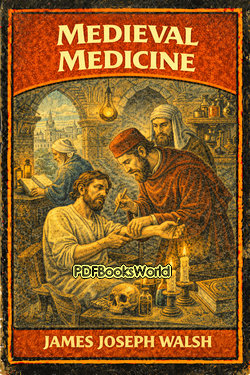
Medieval Medicine
by James Joseph Walsh
The Surprising Medical Knowledge of the Middle Ages
Medieval Medicine by James Joseph Walsh challenges the common belief that the Middle Ages were entirely lacking in scientific and medical progress. The book explores how physicians, scholars, and religious institutions contributed to healthcare during medieval times, often preserving and expanding medical knowledge that later influenced modern medicine.
Walsh presents a more balanced view of medieval healthcare by examining universities, hospitals, surgical practices, and the study of disease during the period. Rather than portraying the era as medically ignorant, the book highlights the important foundations laid by medieval scholars and physicians.
The Preservation of Ancient Medical Learning
One of the book’s major themes is the role medieval scholars played in preserving knowledge from ancient Greece and Rome. Medical writings from figures such as Hippocrates and Galen survived largely because they were copied, studied, and taught during the medieval period.
Monasteries, libraries, and early universities became important centers for education and medical study. This preservation helped later generations continue scientific development.
The Growth of Hospitals and Medical Schools
Walsh explains how medieval Europe saw the development of organized hospitals and institutions dedicated to caring for the sick. Many hospitals were connected to religious communities that viewed caregiving as both a moral and spiritual responsibility.
The rise of universities also improved medical education. Students began studying anatomy, diagnosis, and treatment in more structured academic environments.
Important Subjects Explored in the Book
- The influence of ancient Greek and Roman medicine
- The growth of medieval hospitals and universities
- Surgical practices during the Middle Ages
- The relationship between religion and healthcare
- The preservation of scientific and medical knowledge
These topics reveal how medieval medicine contributed more to history than many people assume.
The Role of Religion in Healthcare
The book discusses how religious institutions played a major role in medical care during the medieval era. Monks, nuns, and church-supported communities often provided treatment for the poor, elderly, and sick.
While spiritual beliefs strongly influenced healthcare, Walsh argues that many religious scholars also valued careful observation and practical treatment methods.
A Different Perspective on the Middle Ages
One of the most interesting aspects of Medieval Medicine is its attempt to correct exaggerated stereotypes about the medieval world. Walsh emphasizes that scientific curiosity and medical learning continued throughout the period, even if progress was slower than in later centuries.
The book encourages readers to see medieval medicine as part of a continuous historical development rather than as a completely isolated or backward era.
Why the Book Still Holds Historical Value
Today, Medieval Medicine remains important for readers interested in the history of science and healthcare. The work offers insight into how societies dealt with disease, education, and patient care long before modern technology existed.
For historians, students, and readers curious about the roots of medical science, James Joseph Walsh’s book provides a thoughtful exploration of how medieval physicians and scholars helped shape the future of medicine.
Similar Genres
About the Author
James Joseph Walsh was an American physician, educator, historian, and author whose writings explored the history of medicine, science, and education with remarkable depth and clarity. Alongside his successful medical career, he developed a lifelong interest in understanding how medical knowledge evolved through different civilizations and historical periods. Explore James Joseph Walsh books to discover the author's life, literary career, and access notable works.