
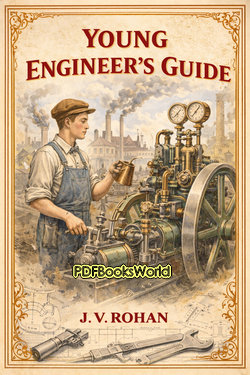
Young Engineer's Guide
by J. V. Rohan
An Introduction to the Principles and Practice of Engineering
Young Engineer's Guide by J. V. Rohan is an educational work designed to introduce aspiring engineers and technically minded readers to the fundamental concepts of engineering. Written during a period when industrial development and technological innovation were transforming society, the book seeks to provide practical knowledge while encouraging curiosity about the machines, structures, and systems that shape the modern world.
Combining theoretical explanations with practical applications, the guide serves as both an instructional manual and an introduction to the engineering profession. Its purpose is not merely to teach technical facts but also to cultivate habits of observation, problem-solving, and careful reasoning.
The work reflects the growing importance of technical education during the industrial age.
The Purpose of Engineering Education
Engineering involves the application of scientific and mathematical principles to solve practical problems. Rohan presents the subject as a discipline that combines knowledge, creativity, and responsibility.
The guide is intended to help readers understand how engineers design, construct, and improve the tools and systems that support everyday life. By explaining essential concepts in accessible language, the book makes technical subjects more approachable for beginners.
This educational mission lies at the heart of the work.
Fundamental Engineering Concepts
The book introduces readers to many of the principles that form the foundation of engineering practice. These concepts help explain how machines operate and how structures withstand various forces.
Among the topics likely emphasized are:
- Mechanics and the laws of motion.
- Forces, energy, and power.
- Materials and their properties.
- Machines and mechanical systems.
By understanding these ideas, readers gain insight into the scientific principles behind engineering achievements.
The Importance of Practical Knowledge
A key feature of the guide is its focus on practical application. Rohan recognizes that engineering is not solely an academic subject; it is also a profession concerned with real-world challenges.
The book encourages readers to observe how machines and structures function in everyday life. Through practical examples and explanations, abstract principles become easier to understand and apply.
This emphasis on usefulness reflects the educational priorities of technical training during the period.
Engineering and Industrial Progress
The guide was written during an era when engineering played a central role in economic and social development. Railways, bridges, factories, ships, and communication systems were transforming the world, and engineers were at the forefront of these changes.
Rohan's work reflects the optimism associated with technological advancement. Engineering is presented as a field capable of improving transportation, industry, infrastructure, and quality of life.
This broader perspective helps readers appreciate the significance of technical professions.
Developing Technical Skills
Beyond presenting information, the book encourages the development of skills essential to successful engineering work. These include analytical thinking, precision, and attention to detail.
Readers are encouraged to approach problems methodically and to rely on observation and evidence when seeking solutions. Such habits remain fundamental to engineering education today.
The guide therefore serves not only as a source of knowledge but also as a training tool for developing an engineering mindset.
A Historical View of Technical Education
Modern readers may find the book valuable as a historical document illustrating how engineering was taught in an earlier era. While technology has advanced dramatically, many of the foundational principles discussed remain unchanged.
The work provides insight into the educational methods and professional expectations of its time. It demonstrates the importance placed on practical knowledge, discipline, and technical competence.
This historical perspective enhances the book's significance beyond its instructional content.
Final Thoughts
Young Engineer's Guide by J. V. Rohan is an informative introduction to the principles, practices, and responsibilities of engineering. Through accessible explanations and practical examples, the book encourages readers to understand the scientific foundations of technology while developing the habits of thought necessary for technical work.
For readers interested in engineering history, technical education, industrial development, and the fundamentals of mechanical science, this guide offers a valuable and engaging starting point.
Similar Genres
About the Author
J. V. Rohan was an engineering author and educator whose practical writings introduced students and aspiring engineers to the principles of mechanical and civil engineering. His work focused on explaining technical concepts in a straightforward manner, helping readers develop the knowledge and skills needed for professional and industrial careers. Explore J. V. Rohan books to discover the author's life, literary career, and access notable works.