
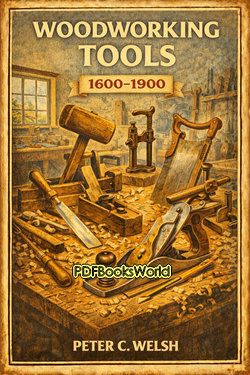
Woodworking Tools 1600-1900
by Peter C. Welsh
The Craftsmanship and History Behind Traditional Woodworking Tools
Woodworking Tools 1600-1900 by Peter C. Welsh is a detailed historical study exploring the development, design, and practical use of woodworking tools across three centuries of craftsmanship. The book examines how carpenters, cabinetmakers, builders, and skilled artisans relied on hand tools to shape wood into furniture, buildings, ships, and everyday objects long before modern machinery transformed industry.
Combining industrial history, craftsmanship, and cultural study, the work reveals how woodworking tools evolved alongside changes in technology, trade, and American society.
The Importance of Woodworking in Everyday Life
Between the seventeenth and nineteenth centuries, woodworking played a central role in daily life and economic activity. Homes, wagons, furniture, tools, ships, and public buildings all depended on skilled woodworkers.
Because machines were limited during much of this period, craftsmen relied heavily on carefully designed hand tools to cut, shape, smooth, and join wood with precision.
Welsh explains how the quality of tools often determined the quality and efficiency of the finished work.
The Evolution of Woodworking Tools
The book traces how woodworking tools gradually improved over time as craftsmanship, metallurgy, and manufacturing techniques advanced. Early tools were often handmade by blacksmiths and local craftsmen, while later centuries introduced more specialized production methods.
Readers encounter a wide variety of traditional tools used for different woodworking tasks.
- Planes used for smoothing and shaping wood
- Saws designed for cutting different materials and angles
- Chisels, hammers, and carving tools
- Measuring and marking instruments for accurate craftsmanship
These tools reveal the remarkable skill and precision required in traditional woodworking.
Craftsmanship and Skilled Labor
One of the book’s strongest themes is respect for craftsmanship and manual skill. Woodworkers required patience, training, and experience to create durable and beautiful products using hand tools alone.
The work highlights how artisans developed specialized techniques passed from one generation to another through apprenticeships and workshops.
This historical focus helps readers appreciate the labor and creativity involved in pre-industrial craftsmanship.
The Relationship Between Tools and Industrial Change
As industrialization expanded during the nineteenth century, woodworking tools and production methods began to change rapidly. Factories introduced mass production, standardized designs, and machine-powered equipment.
Welsh examines how these developments affected traditional craftsmanship and the role of skilled hand labor in American industry.
The book captures an important transitional period between handmade craftsmanship and modern industrial production.
The Writing Style of Peter C. Welsh
Peter C. Welsh writes in a careful and informative style that balances technical detail with historical explanation. Although the subject involves specialized tools and craftsmanship, the book remains understandable and engaging for general readers interested in history and traditional trades.
His descriptions often reveal admiration for the ingenuity and skill of earlier craftsmen.
The combination of historical context and practical explanation gives the work lasting educational value.
Why Woodworking Tools 1600-1900 Still Interests Readers
Woodworking Tools 1600-1900 remains valuable because it preserves the history of traditional craftsmanship during a period that shaped modern industry and construction.
For readers interested in woodworking, industrial history, craftsmanship, design, and historical tools, Peter C. Welsh’s work offers a fascinating look into the skills, labor, and creativity behind centuries of handmade construction and woodworking tradition.
Similar Genres
About the Author
Peter C. Welsh was an American historian, museum curator, and author who specialized in the history of tools, craftsmanship, and early technology. His work focused on preserving the knowledge of traditional woodworking and the skilled trades that helped build homes, furniture, ships, and countless everyday objects. Explore Peter C. Welsh books to discover the author's life, literary career, and access notable works.