
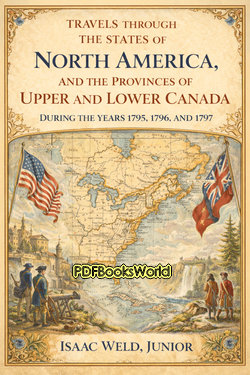
Travels through the states of North America, and the provinces of Upper and Lower Canada
by Isaac Weld
A Remarkable Journey Through North America at the Close of the Eighteenth Century
Travels through the States of North America, and the Provinces of Upper and Lower Canada by Isaac Weld is one of the most important travel narratives of the early modern era. Based on Weld's extensive journey across the United States and Canada during the 1790s, the book provides a detailed account of landscapes, cities, customs, economies, and political institutions in a region undergoing rapid development following the American Revolution.
Written with the curiosity of a traveler and the attention to detail of an observer, the work offers readers a vivid portrait of North America during a formative period in its history. Weld records not only what he saw but also his impressions of the societies he encountered, creating a valuable blend of travel literature, geography, and social commentary.
The book remains an important resource for historians and readers interested in the early history of the continent.
Isaac Weld's North American Expedition
Isaac Weld, an Irish traveler and writer, embarked on a lengthy tour of North America between 1795 and 1797. His travels carried him through many of the young United States and into the British provinces of Upper and Lower Canada.
Unlike many travelers who confined themselves to major cities, Weld ventured into frontier regions and remote landscapes. His observations encompass urban centers, agricultural communities, wilderness areas, and transportation routes, providing a broad view of life across the continent.
This extensive coverage is one of the work's greatest strengths.
The Young United States
One of the book's most fascinating aspects is its description of the United States only a few years after independence. Weld encountered a nation still defining its identity and institutions.
He comments on:
- The growth of American cities and towns.
- Political life in the new republic.
- Commerce and economic development.
- The character and customs of the population.
These observations provide valuable insight into how contemporary visitors viewed the emerging nation.
Upper and Lower Canada
Weld also devoted significant attention to the British colonies of Upper and Lower Canada. His descriptions explore the differences between these provinces and the neighboring United States.
He records details about settlement patterns, agriculture, local government, and everyday life. Readers gain a clearer understanding of how Canadian society developed during the late eighteenth century and how it differed from conditions south of the border.
These accounts make the book particularly valuable for Canadian historical studies.
The Natural Landscape of North America
Beyond cities and settlements, Weld was deeply interested in the continent's natural features. His descriptions of rivers, forests, mountains, and waterfalls reveal both admiration and scientific curiosity.
Among the most memorable portions of the book are his observations of natural landmarks and wilderness regions that impressed European visitors with their scale and beauty. Such passages capture the sense of wonder that many travelers experienced when encountering North America's vast landscapes.
The work preserves valuable descriptions of environments that have changed considerably over time.
Travel, Transportation, and Frontier Life
Travel in the late eighteenth century was often difficult and unpredictable. Weld's narrative records the practical realities of moving across a large and developing continent.
Road conditions, river transport, inns, frontier settlements, and communication networks all receive attention. These details help modern readers appreciate the challenges faced by travelers during an era before railroads and modern infrastructure.
The book therefore serves as a useful record of transportation and daily life.
A Historical Document of Lasting Value
Today, Travels through the States of North America, and the Provinces of Upper and Lower Canada is valued not only as a travel narrative but also as an important historical source. Weld's observations preserve information about communities, landscapes, and institutions during a period of significant change.
Historians frequently consult such firsthand accounts because they reveal how contemporary observers interpreted the societies around them. While Weld's views naturally reflect his own background and assumptions, they provide an informative perspective on North America at the end of the eighteenth century.
This historical significance has ensured the book's enduring reputation.
Final Thoughts
Travels through the States of North America, and the Provinces of Upper and Lower Canada by Isaac Weld is a fascinating account of a continent in transition. Through detailed observations of cities, frontier settlements, political institutions, and natural landscapes, Weld offers readers a valuable glimpse into North America during its formative years.
For readers interested in travel literature, American and Canadian history, geography, and firsthand historical accounts, this work remains an engaging and informative record of exploration and observation at the close of the eighteenth century.
Similar Genres
About the Author
Isaac Weld was an Irish travel writer, explorer, and scientific observer whose detailed accounts of North America made him one of the notable travel authors of the late eighteenth and early nineteenth centuries. Driven by a curiosity about geography, natural history, and the customs of different societies, Weld journeyed through the United States and Canada, carefully recording his observations. Explore Isaac Weld books to discover the author's life, literary career, and access notable works.