
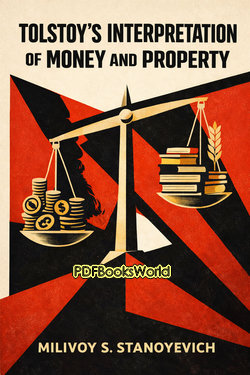
Tolstoy's interpretation of money and property
by Milivoy Stoyan Stanoyevich
An Examination of Tolstoy's Economic and Moral Philosophy
Tolstoy's Interpretation of Money and Property by Milivoy Stoyan Stanoyevich is a thoughtful study of the social, economic, and ethical ideas of the Russian writer and philosopher Leo Tolstoy. Rather than focusing on Tolstoy's novels, the book examines his views on wealth, ownership, labor, and social justice, exploring how his moral convictions shaped his understanding of economic life. Stanoyevich presents Tolstoy not only as a literary giant but also as an influential social thinker whose ideas challenged many assumptions about property and material possessions.
Tolstoy as a Social Critic
In the later years of his life, Leo Tolstoy became deeply concerned with questions of inequality, poverty, and moral responsibility. He argued that many social problems were rooted in unjust economic arrangements and the excessive accumulation of wealth. His writings frequently questioned accepted institutions and encouraged individuals to live according to principles of simplicity, compassion, and nonviolence.
Stanoyevich explores these concerns in detail throughout the study.
Major Subjects Covered
- Money: Tolstoy's views on wealth and economic relationships.
- Property: His critique of ownership and accumulation.
- Labor: The dignity and moral value of productive work.
- Social Justice: Concerns regarding poverty and inequality.
- Ethics: The connection between moral principles and economic behavior.
The Moral Dimension of Economics
Tolstoy approached economic questions primarily as moral issues. He believed that discussions of money and property could not be separated from questions of conscience, responsibility, and human welfare. According to his perspective, individuals should evaluate economic practices in light of their effects on others rather than solely in terms of profit or efficiency.
This ethical emphasis distinguishes his thought from many conventional economic theories.
Property and Ownership
A central topic of the book is Tolstoy's criticism of private property as it existed in his society. He argued that large concentrations of wealth and land ownership often depended upon systems that disadvantaged others. While his conclusions remain subjects of debate, his arguments reflected a deep concern for fairness and human dignity.
Stanoyevich analyzes these ideas within their historical and philosophical context.
Labor and Human Dignity
Tolstoy placed great value on honest labor and frequently emphasized the importance of productive work. He believed that meaningful labor connected individuals to one another and to the broader needs of society. This belief influenced both his personal life and his social philosophy.
The study highlights how central this principle was to his worldview.
Historical Context
The book situates Tolstoy's ideas within the social and economic conditions of nineteenth-century Russia. Vast inequalities, rural poverty, and debates over reform shaped the environment in which he developed his views. Understanding this context helps explain both the strengths and limitations of his arguments.
Stanoyevich provides readers with a framework for interpreting Tolstoy's concerns.
A Contribution to Intellectual History
Beyond its discussion of economics, the work contributes to the study of political and social thought. It demonstrates how literary figures can influence debates about justice, ethics, and public policy. Tolstoy's ideas continue to attract attention because they address enduring questions about wealth and human responsibility.
The study serves as a bridge between literature, philosophy, and social theory.
Why the Book Remains Relevant
Modern discussions about inequality, property rights, economic ethics, and social responsibility often touch upon issues that concerned Tolstoy more than a century ago. Readers interested in political philosophy, economic history, and Russian intellectual life will find the book particularly valuable.
Its examination of moral questions surrounding wealth continues to encourage thoughtful reflection.
A Thoughtful Study of Wealth, Ethics, and Society
Tolstoy's Interpretation of Money and Property offers an insightful analysis of one of history's most influential writers as a social and economic thinker. Through careful examination of Tolstoy's views on money, labor, ownership, and justice, Milivoy Stoyan Stanoyevich reveals the depth of the author's moral philosophy. The book remains a useful resource for readers interested in the intersection of literature, ethics, and economic thought.
Similar Genres
About the Author
Milivoy Stoyan Stanoyevich was a Serbian-American scholar, educator, translator, and author whose work focused on literature, philosophy, economics, and international affairs. Throughout his academic career, he sought to explain complex social and political ideas through careful research and thoughtful analysis. Explore Milivoy Stoyan Stanoyevich books to discover the author's life, literary career, and access notable works.