
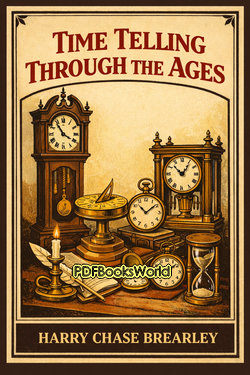
Time Telling through the Ages
by Harry Chase Brearley
From Sundials to Mechanical Clocks: Humanity’s Long Search to Measure Time
Long before digital watches and smartphones displayed time instantly, people relied on shadows, candles, water, stars, and carefully engineered machines to track the passing hours. Time Telling through the Ages by Harry Chase Brearley traces the fascinating history of how civilizations developed increasingly sophisticated methods for measuring time.
The book transforms an everyday concept into a rich historical journey through science, astronomy, craftsmanship, religion, and human ingenuity.
When Nature Served as the First Clock
Early civilizations measured time by observing natural patterns. Sunrise and sunset divided day from night, while changing seasons guided agriculture, travel, and religious ceremonies.
Gradually, people began creating tools that could track time more precisely.
Among the earliest methods were:
- Sundials using shadows cast by sunlight
- Water clocks controlling the steady movement of liquid
- Hourglasses measuring duration through flowing sand
- Candle clocks estimating time through burning wax
These inventions reflected humanity’s growing desire to organize daily life and understand the natural world.
The Mechanical Clock Revolution
One of the book’s most interesting sections explores the arrival of mechanical clocks during the Middle Ages and Renaissance.
Clockmaking became both a scientific and artistic achievement. Large public clocks appeared in towers and churches, allowing entire communities to coordinate work, prayer, and commerce according to shared schedules.
The development of gears, pendulums, springs, and precision engineering gradually improved accuracy.
Timekeeping became increasingly connected with urban life, trade, and scientific progress.
Why Accurate Timekeeping Changed Civilization
Brearley shows that measuring time affected far more than personal convenience.
Improved clocks influenced:
- Navigation and sea travel
- Scientific observation and astronomy
- Industrial work schedules
- Railroad coordination and transportation
- Daily routines within modern cities
As societies became more technologically advanced, accurate timekeeping grew increasingly essential.
The Beauty of Historical Clocks
Beyond science and engineering, the book also celebrates the artistry of clockmaking.
Many historical clocks were designed as decorative masterpieces filled with carved wood, engraved metal, painted faces, and elaborate mechanisms.
Craftsmanship mattered almost as much as precision.
Clockmakers combined mathematics, engineering, and artistic design into objects that symbolized both wealth and intellectual achievement.
The Writing Style of Harry Chase Brearley
Brearley writes with enthusiasm and curiosity, making technical history approachable for general readers. Scientific explanation is balanced with historical storytelling and vivid description.
The narrative moves smoothly across centuries, showing how different cultures contributed to humanity’s understanding of time measurement.
The result feels educational without losing its sense of wonder.
Why Time Telling through the Ages Still Fascinates Readers
Time Telling through the Ages remains compelling because time governs nearly every aspect of modern life, yet its measurement required centuries of invention and experimentation.
For readers interested in scientific history, ancient technology, astronomy, craftsmanship, and the evolution of civilization, Harry Chase Brearley’s book offers an engaging exploration of humanity’s timeless effort to understand and organize the passing hours.
Similar Genres
About the Author
Harry Chase Brearley was an American author, historian, and researcher with a strong interest in the history of science, technology, and human innovation. His writings explored how everyday inventions and practical discoveries shaped civilization over the centuries. Explore Harry Chase Brearley books to discover the author's life, literary career, and access notable works.