
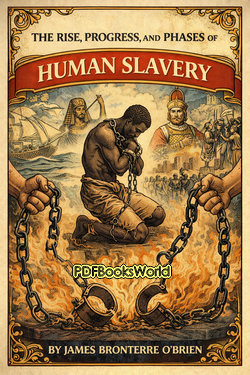
The rise, progress, and phases of human slavery
by James Bronterre O'Brien
A Historical and Political Examination of Slavery
The Rise, Progress, and Phases of Human Slavery by James Bronterre O'Brien is a powerful historical and political study that examines slavery as a social institution across different periods of human history. O'Brien, a prominent political reformer and social critic, approaches the subject not merely as a moral issue but as a phenomenon deeply connected to economic systems, political power, and class relations.
The work seeks to trace the origins of slavery, analyze the conditions that allowed it to develop, and explore the various forms it assumed in different societies. By placing slavery within a broad historical framework, O'Brien encourages readers to consider how systems of domination evolve and how they affect both individuals and entire civilizations.
The book stands as an ambitious attempt to understand one of humanity's most enduring and troubling institutions.
The Origins of Slavery
O'Brien begins by examining the emergence of slavery in early societies. Rather than viewing it as an isolated practice, he investigates the social and economic circumstances that contributed to its development.
As communities grew larger and more complex, differences in wealth, power, and status often increased. Conquest, warfare, and control of resources frequently played important roles in creating systems through which one group exercised authority over another.
By exploring these foundations, O'Brien seeks to explain why slavery appeared in many regions and historical periods rather than treating it as an exceptional occurrence.
Slavery Through the Ages
A major strength of the book is its broad historical scope. O'Brien examines slavery in a variety of societies, highlighting both similarities and differences in how the institution functioned.
His discussion considers:
- Ancient systems of slavery and forced labor.
- The relationship between conquest and enslavement.
- Economic interests that sustained slave systems.
- The social consequences of unequal power structures.
This comparative approach helps readers understand slavery as a recurring historical phenomenon rather than a problem confined to a single era or nation.
Economic and Political Dimensions
One of O'Brien's central arguments is that slavery cannot be understood solely through individual acts of cruelty or injustice. He emphasizes the larger economic and political structures that benefited from forced labor and maintained systems of dependence.
According to this perspective, institutions of oppression often survive because they serve powerful interests. The book therefore examines how governments, economic elites, and social hierarchies contributed to the continuation of slavery throughout history.
This analysis reflects O'Brien's broader interest in social reform and economic justice.
James Bronterre O'Brien as a Social Critic
James Bronterre O'Brien was a significant figure in nineteenth-century political thought, particularly within reform movements that sought greater social and economic equality. His writings frequently challenged existing power structures and encouraged readers to question accepted assumptions about society.
In this work, his perspective extends beyond historical narration. He uses history as a means of examining contemporary social issues and encouraging critical reflection on systems of privilege and inequality.
His approach gives the book both historical importance and political significance.
The Broader Meaning of Freedom
Although the book focuses on slavery, it is equally concerned with the concept of freedom. O'Brien invites readers to consider what genuine liberty requires and how societies can move beyond systems of domination.
He explores questions about human rights, personal autonomy, and social responsibility. These themes elevate the discussion beyond a study of past institutions and transform it into a broader examination of justice and human dignity.
The work's moral force derives from this commitment to understanding and defending freedom.
Historical Value and Modern Relevance
Today, the book remains valuable as both a historical study and a reflection of nineteenth-century reformist thought. While modern scholarship has expanded and refined understanding of slavery, O'Brien's effort to connect historical analysis with social critique continues to be noteworthy.
The questions he raises about power, inequality, and human rights remain relevant in contemporary discussions about social justice and historical memory.
His work encourages readers to view history not merely as a record of events but as a source of insight into ongoing human challenges.
Final Thoughts
The Rise, Progress, and Phases of Human Slavery by James Bronterre O'Brien is a thoughtful and wide-ranging examination of slavery as a historical, economic, and political institution. Through careful analysis and social criticism, O'Brien seeks to explain how systems of oppression emerge, endure, and ultimately face challenge.
For readers interested in history, political thought, social reform, and the study of human freedom, this work offers a significant and thought-provoking perspective on one of the most important issues in world history.
Similar Genres
About the Author
James Bronterre O'Brien was an Irish-born British political writer, journalist, reformer, and one of the leading intellectual voices of the Chartist movement. A passionate advocate for political equality, universal suffrage, and social justice, he devoted much of his life to challenging systems of privilege and defending the rights of working people. Explore James Bronterre O'Brien books to discover the author's life, literary career, and access notable works.