
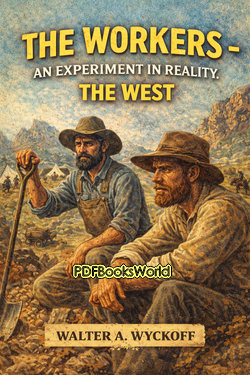
The Workers : An Experiment in Reality. The West
by Walter A. Wyckoff
A Powerful Social Study of Labor and Life in the American West
The Workers: An Experiment in Reality. The West by Walter A. Wyckoff is a significant work of social observation and investigative writing exploring the lives, struggles, and working conditions of laborers in the American West during the late nineteenth century. Part of Wyckoff’s broader social experiment, the book documents his decision to live and work among laborers in order to better understand the realities of working-class life.
Rather than studying poverty and labor from a distance, Wyckoff personally experienced manual labor, travel, hardship, and economic uncertainty. The work combines travel narrative, social criticism, and firsthand observation to present a vivid picture of American labor conditions during a period of industrial expansion and social change.
The book remains an important contribution to labor history and social reform literature.
Experiencing Labor and Hardship Firsthand
Wyckoff travels across western regions of the United States while taking on difficult jobs and living among workers employed in farms, railroads, camps, and other labor-intensive environments. Through these experiences, he observes economic inequality, unstable employment, physical exhaustion, and the uncertainty facing ordinary laborers.
The narrative also captures the landscapes, communities, and rapidly changing social conditions of the American West. Wyckoff’s encounters reveal both the harshness of labor and the resilience and dignity of many workers struggling to survive.
The work emphasizes observation based on direct personal experience rather than abstract theory alone.
The Realistic Style of Walter A. Wyckoff
Walter A. Wyckoff writes in a detailed and reflective style combining journalistic realism with personal narrative. His language remains accessible while carefully documenting conversations, environments, and working conditions.
The book balances sympathy for laborers with thoughtful social analysis, allowing readers to understand both individual experiences and broader economic realities.
Wyckoff’s firsthand approach gives the narrative emotional authenticity and historical value.
Main Themes and Social Concerns
The work explores themes of labor, poverty, economic inequality, survival, social justice, and the realities of working-class life in industrial America. It also reflects the importance of firsthand observation in understanding social problems.
Through direct experience and careful reflection, the book examines how industrial and economic systems shaped the lives of ordinary workers.
Why the Book Still Holds Importance
The Workers: An Experiment in Reality. The West remains historically important because it provides firsthand insight into labor conditions and social inequality during a transformative period in American history. Readers interested in labor studies and social history often value the work for its realism and human perspective.
The book also documents the challenges faced by workers during westward expansion and industrial growth in the United States.
Its themes of economic struggle and social dignity continue to feel relevant.
The Lasting Importance of Investigative Social Writing
Works based on direct social investigation became increasingly influential during the late nineteenth century as writers and reformers sought to expose poverty, labor exploitation, and unequal living conditions. Such books helped shape public discussion about reform and economic justice.
Wyckoff’s experiment in living as a laborer anticipated later traditions of immersive journalism and documentary social writing.
The continuing interest in labor history and social reform helps preserve the significance of works like this.
Final Thoughts
The Workers: An Experiment in Reality. The West by Walter A. Wyckoff is a compelling and historically valuable exploration of labor, hardship, and survival in the American West. Through firsthand experience and careful social observation, Wyckoff presents a vivid portrait of working-class life during an era of rapid economic and industrial change.
For readers interested in labor history, social reform, American history, and investigative writing, this work remains both informative and deeply human.
Similar Genres
About the Author
Walter A. Wyckoff was an American educator, sociologist, author, and social investigator whose pioneering studies of working-class life helped establish new approaches to social research in the late nineteenth century. As a professor at Princeton University, Wyckoff became convinced that social conditions could not be fully understood through statistics and theory alone. Explore Walter A. Wyckoff books to discover the author's life, literary career, and access notable works.