
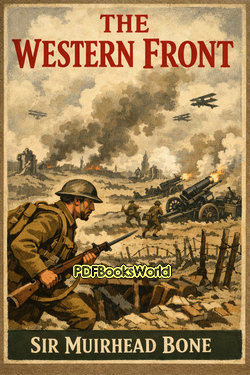
The Western Front
by Sir Muirhead Bone
Artistic Impressions of War Along the Battlefields of World War I
Broken villages, shattered trees, endless trenches, artillery scars, and exhausted soldiers moving through devastated landscapes define the haunting world portrayed in The Western Front by Sir Muirhead Bone. Created during World War I, the work combines visual documentation, artistic observation, and historical testimony to capture the immense destruction and atmosphere of the Western Front.
Rather than presenting war through dramatic fiction alone, the book records the physical reality of industrialized conflict as witnessed by an official war artist.
An Artist Sent to the Front Lines
Muirhead Bone became one of Britain’s first official war artists during World War I. His role involved traveling to military areas and producing detailed drawings of battle zones, military infrastructure, ruined cities, and the daily conditions surrounding the war.
The work therefore serves both artistic and documentary purposes.
Bone’s illustrations preserve visual impressions of places and scenes transformed by mechanized warfare.
The Landscape of Industrial War
One of the book’s strongest themes is the transformation of ordinary landscapes into devastated terrain.
Readers encounter scenes involving:
- Destroyed towns and ruined churches
- Massive trench systems stretching across the countryside
- Artillery-damaged forests and roads
- Military camps, railways, and supply operations
The environment itself becomes evidence of the war’s enormous scale.
War Beyond Heroic Romanticism
Unlike older artistic traditions that often glorified battle, The Western Front emphasizes exhaustion, destruction, labor, and mechanical devastation.
The war appears less like heroic spectacle and more like a vast industrial process reshaping land and human life alike.
Bone’s attention to ruined architecture, machinery, and scarred terrain reflects the modern character of twentieth-century warfare.
The visual atmosphere frequently feels somber and overwhelming.
The Importance of War Art
Before photography became universally dominant in war reporting, artists played a major role in documenting military events and battlefield conditions.
Bone’s work demonstrates how drawing and illustration could capture not only physical detail but also emotional atmosphere and scale.
His images often focus on:
- The immensity of destruction
- The harsh geometry of trenches and machinery
- The vulnerability of human figures within ruined landscapes
- The strange stillness surrounding devastated areas
The artwork becomes historical witness as much as artistic expression.
The Style of Sir Muirhead Bone
Bone’s artistic style emphasizes precision, architectural structure, and dramatic composition. His drawings often balance technical detail with emotional weight.
Even without graphic violence, the devastation remains powerfully visible through ruined environments and damaged infrastructure.
The combination of realism and atmosphere gives the work enduring historical significance.
Why The Western Front Still Matters
The Western Front remains important because World War I fundamentally changed modern warfare, politics, and collective memory. Bone’s work preserves visual testimony from one of history’s most destructive conflicts.
For readers interested in war art, military history, World War I studies, battlefield landscapes, and historical illustration, Sir Muirhead Bone’s work offers a powerful and deeply human record of war’s impact on both land and civilization.
Similar Genres
About the Author
Sir Muirhead Bone was a Scottish artist, illustrator, and author whose remarkable drawings of landscapes, architecture, industry, and wartime scenes earned him international recognition. Regarded as one of Britain's finest etchers and draftsmen, he possessed an extraordinary ability to capture detail, atmosphere, and human activity with precision and artistic sensitivity. Explore Sir Muirhead Bone books to discover the author's life, literary career, and access notable works.