
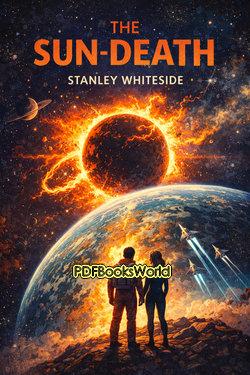
The Sun-Death
by Stanley Whiteside
Cosmic Catastrophe, Human Survival, and the Terror of a Dying Star
The Sun-Death by Stanley Whiteside is a dramatic science fiction story exploring planetary survival, cosmic disaster, and humanity’s struggle against forces beyond human control. Written during the golden age of pulp science fiction, the story combines scientific speculation, suspense, and apocalyptic imagination while examining how civilization reacts when the very source of life in the Solar System begins facing destruction.
Whiteside presents the universe not as a stable and permanent environment, but as a fragile cosmic system where even the sun itself may become a source of fear and extinction.
A Civilization Facing Extinction
The story unfolds as scientists and political authorities discover terrifying evidence that the sun is undergoing catastrophic changes threatening Earth and possibly the entire Solar System. Strange environmental conditions, shifting temperatures, and growing scientific alarm create panic as humanity realizes its dependence upon a star that may no longer remain stable.
As the crisis deepens, governments, researchers, and ordinary citizens confront impossible questions concerning survival, escape, and the future of civilization. Scientific efforts to understand or halt the approaching catastrophe become increasingly desperate as time runs short.
The narrative emphasizes not only the physical danger posed by cosmic collapse, but also the emotional and psychological strain created when humanity confronts the possibility of universal destruction.
Rather than portraying science as all-powerful, the story highlights the limitations of human knowledge when faced with forces operating on astronomical scales.
The volume reflects classic pulp-era fascination with cosmic disasters and humanity’s vulnerability within the immense universe.
Its tone combines urgency, suspense, scientific wonder, and apocalyptic tension.
Characters
- The Scientist-Protagonist: A researcher struggling to understand and possibly prevent the approaching solar catastrophe.
- Political and Military Authorities: Leaders attempting to maintain order during growing fear and uncertainty.
- Ordinary Citizens: Humanity confronted with panic, despair, and hope during civilization’s greatest crisis.
- Scientific Collaborators: Researchers and engineers seeking solutions against overwhelming cosmic danger.
The Fragility of Human Civilization
A major theme throughout the story is the vulnerability of human life within a universe governed by immense natural forces. Whiteside repeatedly explores how technological achievement and social organization may prove powerless against cosmic-scale events.
The work also reflects broader twentieth-century anxieties concerning global destruction, scientific uncertainty, and humanity’s dependence upon environmental stability.
This combination of scientific imagination and existential fear gives the narrative much of its dramatic power.
Science Fiction Themes Explored Throughout the Story
- Cosmic Disaster and Solar Collapse: The stability of the sun becomes humanity’s greatest threat.
- Scientific Investigation and Survival: Researchers race to understand catastrophic astronomical changes.
- Human Vulnerability in the Universe: Civilization faces forces far beyond ordinary human control.
- Fear, Panic, and Social Stability: Society struggles to respond rationally during approaching extinction.
- The Limits of Science and Technology: Human knowledge encounters terrifying cosmic uncertainty.
The story reflects many classic qualities associated with apocalyptic and scientifically imaginative pulp fiction.
The Terror of Cosmic Indifference
One of the work’s strongest ideas is that humanity exists within a universe unconcerned with human survival or ambition. Whiteside repeatedly demonstrates how fragile civilization becomes when confronted with astronomical forces operating beyond emotional or moral consideration.
The story also reveals enduring science fiction fascination with end-of-the-world scenarios shaped not by war alone, but by the vast and indifferent processes of the cosmos itself.
This blend of scientific speculation and existential dread gives the narrative lasting imaginative impact.
Stanley Whiteside’s Dramatic Science Fiction Style
The Sun-Death demonstrates Stanley Whiteside’s ability to combine speculative astronomy, emotional tension, and fast-moving storytelling into entertaining cosmic adventure fiction.
The writing remains vivid, suspenseful, and strongly focused upon maintaining urgency and large-scale imaginative atmosphere throughout the narrative.
Whiteside consistently presents outer space as both awe-inspiring and deeply threatening.
Why the Story Still Holds Science Fiction Interest
Modern readers continue finding The Sun-Death compelling because its themes of environmental collapse, scientific uncertainty, and global vulnerability remain highly relevant today.
The story also reflects the imaginative ambition of classic pulp science fiction, where cosmic-scale dangers challenged humanity’s confidence and understanding.
Its themes of survival, scientific responsibility, fear, and cosmic catastrophe continue appealing to readers interested in apocalyptic speculative fiction and grand astronomical adventure.
For readers interested in cosmic disaster stories, pulp science fiction, apocalyptic futures, speculative astronomy, planetary survival, and classic space-age imagination, this work remains suspenseful, imaginative, and powerfully dramatic.
Similar Genres
About the Author
Stanley Whiteside was a science fiction writer whose work reflects the imaginative spirit of classic pulp fiction, where bold ideas and adventurous storytelling took readers far beyond the boundaries of everyday life. Explore Stanley Whiteside books to discover the author's life, literary career, and access notable works.