
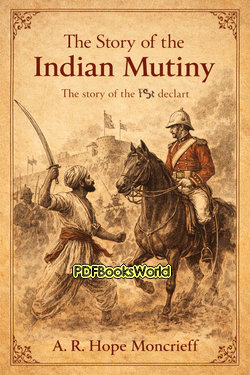
The Story of the Indian Mutiny
by Ascot Moncrieff
A Historical Account of Rebellion, Conflict, and Empire in Nineteenth-Century India
The Story of the Indian Mutiny by Ascot Moncrieff is a historical narrative examining the Indian Rebellion of 1857, one of the most significant and violent conflicts in the history of British rule in India. Written from a British historical perspective common to its period, the book recounts the military events, political tensions, and dramatic episodes associated with the uprising that challenged the authority of the British East India Company.
The conflict, known historically as the Indian Mutiny, the Sepoy Rebellion, or the First War of Indian Independence depending on perspective, involved soldiers, rulers, civilians, and entire regions reacting against political control, military grievances, and cultural tensions.
The work blends military history with imperial narrative and historical storytelling.
The Uprising of 1857
The book describes the outbreak of rebellion among Indian soldiers serving under British command, particularly within the Bengal Army of the East India Company. Military unrest rapidly expanded into broader political and social conflict across northern and central India.
The Indian Mutiny of 1857: A major anti-colonial uprising involving Indian soldiers, local rulers, and civilians resisting British authority during the nineteenth century.
The narrative likely includes major events such as the sieges of Delhi, Lucknow, and Cawnpore, along with military campaigns and dramatic acts of resistance and retaliation.
The atmosphere reflects violence, uncertainty, political upheaval, and imperial crisis.
The Historical Style of Ascot Moncrieff
Ascot Moncrieff writes in a dramatic and descriptive style emphasizing military action, heroism, and historical narrative. Like many British historians of his era, he presents the events through perspectives shaped by imperial attitudes and nineteenth-century interpretations.
The prose combines historical detail with emotional storytelling and battlefield description.
Modern readers often approach such works critically while recognizing their value as historical documents reflecting contemporary viewpoints.
Main Themes and Historical Reflection
The book explores themes of rebellion, empire, military loyalty, colonial authority, resistance, political conflict, cultural tension, and national identity. It also reflects the complex and often violent relationship between imperial power and colonized societies.
Through military narrative and historical commentary, the work examines how political control and cultural misunderstanding contributed to large-scale conflict.
Why the Book Still Holds Importance
The Story of the Indian Mutiny remains historically important because the events of 1857 profoundly changed British rule in India and influenced later nationalist movements. Historians continue to study the uprising from multiple perspectives including military, political, and anti-colonial interpretations.
The book also provides insight into how British writers of the late nineteenth and early twentieth centuries understood imperial conflict.
Its detailed narrative and historical perspective continue to make it informative.
The Lasting Importance of the 1857 Rebellion
The uprising of 1857 marked a turning point in Indian and British imperial history. After the rebellion, control of India passed from the East India Company directly to the British Crown, reshaping colonial administration and political policy.
For many Indians, the rebellion later became an important symbol of resistance against colonial rule and an early stage in the struggle for independence.
The continuing study of colonial history and anti-imperial movements helps preserve attention toward works like this.
Final Thoughts
The Story of the Indian Mutiny by Ascot Moncrieff is a dramatic historical account exploring the rebellion of 1857 and the political, military, and cultural conflicts surrounding British rule in India. Through detailed narrative and historical interpretation, the book illuminates one of the defining crises of the nineteenth-century British Empire.
For readers interested in colonial history, military conflict, Indian history, and imperial studies, this work remains both historically significant and intellectually revealing.
Similar Genres
About the Author
Ascot Moncrieff was a British military historian and author whose writings focused on important events in imperial and military history. His books sought to make complex historical conflicts understandable to general readers by combining careful research with engaging storytelling. Explore Ascot Moncrieff books to discover the author's life, literary career, and access notable works.