
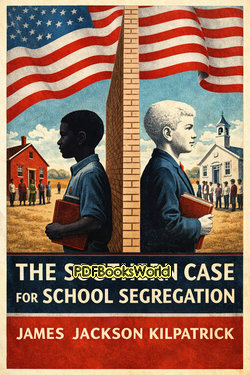
The Southern Case for School Segregation
by James Jackson Kilpatrick
A Controversial Defense of Segregation During the Civil Rights Era
The Southern Case for School Segregation by James Jackson Kilpatrick is a historically significant but highly controversial work that emerged during one of the most turbulent periods in American history. Published in the aftermath of the landmark 1954 Supreme Court decision Brown v. Board of Education, the book presents arguments in favor of maintaining racially segregated schools in the American South. Today, the work is studied primarily as a historical document that reflects the political and social resistance to the civil rights movement rather than as a credible guide to educational policy.
Kilpatrick, a journalist and editor, became one of the most prominent public advocates of the segregationist position during the 1950s and early 1960s. His book sought to provide intellectual and constitutional arguments against federally mandated school desegregation, appealing to readers who opposed the rapid social changes taking place across the United States.
Historical Background
To understand the book, it is essential to place it within its historical context. The Supreme Court's decision in Brown v. Board of Education declared racial segregation in public schools unconstitutional, overturning the legal framework that had supported segregation for decades.
The ruling sparked intense debate and opposition in many Southern states. Political leaders, journalists, and activists who favored segregation developed various arguments to defend existing institutions and resist federal intervention.
Kilpatrick's book became one of the best-known expressions of this resistance, reflecting the broader movement often referred to as "Massive Resistance."
The Author's Arguments
Rather than focusing primarily on educational outcomes, Kilpatrick framed his case around constitutional interpretation, states' rights, and local control of government. He argued that federal authority was being expanded beyond its proper limits and that states should retain significant power over educational policy.
The book attempts to support these claims through legal reasoning, historical references, and political commentary. Modern scholars, however, generally view these arguments as part of a broader effort to preserve racial segregation rather than as objective constitutional analysis.
A Reflection of Its Time
One reason the book remains historically important is that it reveals how segregation was defended by educated and influential figures during the civil rights era. Rather than relying solely on overt appeals to prejudice, some segregationist writers sought to present their views through legal, political, and intellectual frameworks.
This makes the work valuable for understanding:
- The arguments used by opponents of desegregation.
- The political climate of the 1950s South.
- The resistance faced by the civil rights movement.
- The public debates surrounding constitutional authority.
Modern Historical Assessment
Today, historians generally study The Southern Case for School Segregation as an example of segregationist thought rather than as a persuasive policy work. Subsequent legal decisions, civil rights legislation, and social developments overwhelmingly rejected the principles the book sought to defend.
The work remains useful because it helps explain the nature of the opposition encountered by civil rights activists and demonstrates how deeply entrenched segregation was within parts of American society.
By examining texts such as this, readers gain a fuller understanding of the conflicts that shaped modern American history.
Final Thoughts
The Southern Case for School Segregation by James Jackson Kilpatrick is a controversial historical document that captures the arguments advanced by opponents of school desegregation during the civil rights era. While its central position has been broadly rejected by modern law and society, the book remains significant as a source for understanding the political, legal, and cultural debates surrounding one of the most important struggles for equality in American history.
For readers interested in civil rights history, constitutional debates, political thought, and the history of social change in the United States, the work provides valuable insight into a pivotal and deeply contested period.
Similar Genres
About the Author
James Jackson Kilpatrick was an American journalist, editor, columnist, and author whose career spanned several decades of political and legal commentary. He became widely known for his newspaper editorials, syndicated columns, and television appearances, where he discussed constitutional law, public policy, and current affairs. Explore James Jackson Kilpatrick books to discover the author's life, literary career, and access notable works.