
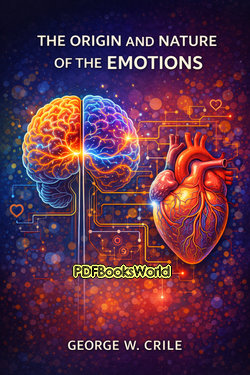
The Origin and Nature of the Emotions
by George W. Crile
Physiology, Survival, and the Biological Origins of Human Emotion
The Origin and Nature of the Emotions by George W. Crile is a scientific and medical work exploring the physiological basis of human emotions and their relationship to survival, bodily reactions, and evolutionary development. Written during the early twentieth century, the book reflects growing scientific interest in psychology, neurology, physiology, and the biological mechanisms underlying emotional experience.
Crile presents emotions not merely as abstract mental states, but as physical responses deeply connected to the nervous system, bodily energy, instinct, and the evolutionary struggle for survival.
The Biological Foundations of Emotion
The book examines how fear, anger, pain, excitement, and other emotional states produce measurable physiological effects within the body. Crile discusses changes involving heart rate, muscular tension, glandular activity, respiration, circulation, and nervous stimulation.
He argues that emotions evolved as survival mechanisms helping organisms respond rapidly to danger, stress, conflict, and environmental challenge.
Rather than separating mind and body entirely, the work demonstrates how emotional experience is closely linked to physical processes occurring within the nervous and endocrine systems.
The volume also reflects the growing influence of experimental medicine and biological psychology during the early twentieth century, when scientists increasingly sought physical explanations for behavior and mental states.
Its tone combines medical investigation with evolutionary theory and physiological analysis.
The Relationship Between Emotion and Survival
A major theme throughout the book is that emotions originated as adaptive biological responses designed to preserve life and improve survival under threatening conditions.
Crile repeatedly explains how fear prepares the body for escape, anger prepares it for struggle, and pain warns against injury or danger.
The work also explores how prolonged emotional strain may exhaust bodily energy and contribute to physical illness or nervous disorders.
This connection between emotion and physiology helped shape later developments in psychosomatic medicine and stress research.
Scientific Topics Explored Throughout the Book
- Emotion and Nervous System Activity: Crile explains how emotions affect bodily processes through neurological stimulation.
- Fear, Anger, and Survival Instincts: The book examines emotional reactions as evolutionary adaptations.
- Physiology and Human Behavior: Emotional experience is connected to circulation, respiration, muscles, and glands.
- Stress, Exhaustion, and Health: The work explores how intense emotional states influence physical wellbeing.
- Evolutionary Psychology and Medicine: Biological theory is used to explain emotional behavior and bodily reactions.
The book reflects early twentieth-century efforts to unify psychology, physiology, and evolutionary science.
The Human Body as an Emotional Organism
One of the work’s strongest ideas is that emotions cannot be fully understood without examining their physical and biological foundations.
Crile repeatedly demonstrates how emotional reactions involve coordinated activity throughout the body rather than isolated mental experiences alone.
The book also shows how scientific medicine increasingly viewed the human organism as an interconnected system linking mind, nerves, organs, and bodily energy.
This physiological approach helped influence later studies of stress, trauma, emotional health, and behavioral medicine.
George W. Crile’s Analytical Medical Style
The Origin and Nature of the Emotions demonstrates George W. Crile’s ability to combine medicine, physiology, psychology, and evolutionary reasoning into organized scientific discussion.
The writing remains analytical, methodical, and strongly focused upon explaining emotional behavior through biological evidence and clinical observation.
Crile consistently presents scientific investigation as essential for understanding the deeper physical mechanisms governing human experience.
Why the Book Still Holds Historical and Scientific Interest
Modern readers continue finding The Origin and Nature of the Emotions historically important because it reflects early scientific attempts to explain emotions through physiology and evolutionary biology before modern neuroscience fully developed.
The book also provides insight into the origins of stress research, psychosomatic medicine, and biological approaches to psychology during a transformative period in medical science.
Its discussions of nervous energy, bodily response, and emotional adaptation remain historically significant within the broader development of psychology, neuroscience, and behavioral medicine.
For readers interested in psychology, physiology, medical history, neuroscience, emotional theory, evolutionary science, and the history of medicine, this work remains intellectually engaging, scientifically influential, and historically revealing.
Similar Genres
About the Author
George W. Crile was an American surgeon, medical researcher, educator, and author whose pioneering work transformed the fields of surgery, physiology, and medical science. As one of the founders of the Cleveland Clinic, he became widely respected for his innovations in surgical techniques, shock treatment, blood transfusion, and the study of the body's response to stress. Explore George W. Crile books to discover the author's life, literary career, and access notable works.